Cognitive Creations Strategy · Governance · PMO · Agentic AI

Agentic AI: Prompt Engineering & Context Engineering

Agentic AI is not a single prompt—it’s an orchestrated workflow: planning, tool use, memory, retrieval, and iterative validation. In that world, prompt engineering remains essential, but context engineering is what makes the system reliable, scalable, and testable in production.

Download as PDF

1 — panel-overview

panel-overview

Summary

Agentic AI is an orchestrated workflow: planning, tool use, memory, retrieval, and iterative validation. Prompt engineering = how you ask; context engineering = what you provide; agentic design = how the system decides, acts, and verifies.

Use the tabs above to jump to definitions, design patterns, examples, checklist, and MCP.

2 — 1 Core definitions: prompt vs. context

1 Core definitions: prompt vs. context

1 Core definitions: prompt vs. context

Prompt engineering is the craft (and increasingly the discipline) of writing instructions that steer model behavior toward a desired outcome—clarity, constraints, examples, and output formats. Think of it as the interface design between a user (or system) and the model.

Context engineering is the system-level discipline of ensuring the model is given what it needs to plausibly accomplish the task: relevant knowledge, policies, tool schemas, state, memory, and constraints within a token budget. It’s less “wordsmithing” and more “systems engineering of the context window.”

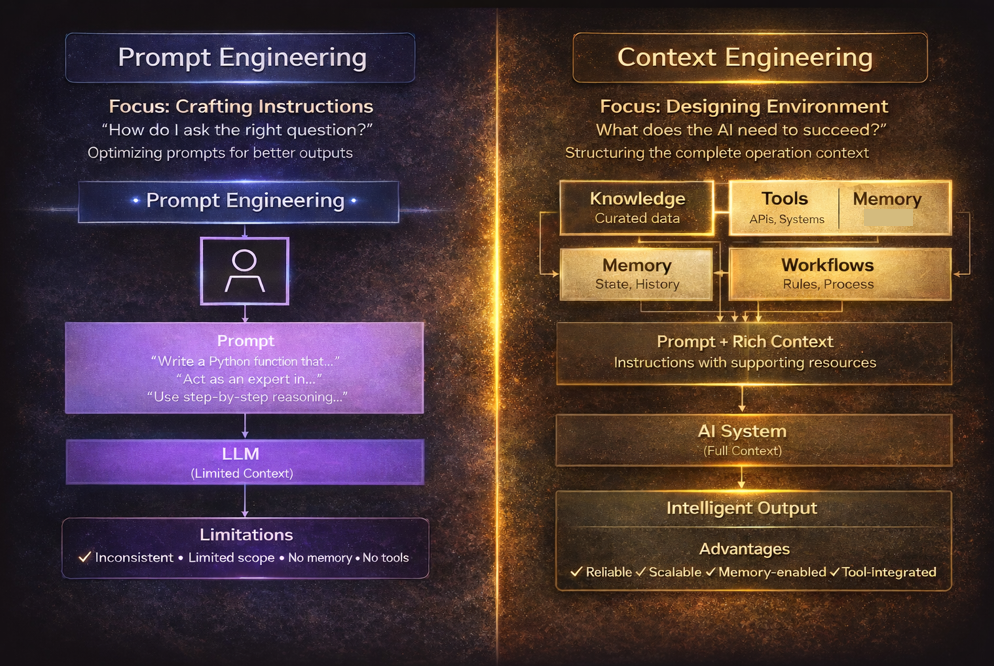
Context Engineering Visual Prompt vs. Context Engineering (img1.png)
Context
Diagram comparing prompt engineering vs context engineering
Use this visual to highlight the key shift: prompts primarily define behavior (how the model responds), while context engineering supplies capability and correctness inputs (facts, tools, state, policies, budget).
Dimension Prompt engineering Context engineering
Primary goal Shape behavior (instruction, style, format, constraints). Supply the right information & tools (relevance, provenance, budget).
Typical artifacts System/dev/user prompts, few-shot examples, rubrics. RAG sources, memory summaries, tool contracts, state objects, policies.
Main failure mode Ambiguity → wrong/verbose/unsafe output. Missing/irrelevant context → hallucinations, tool misuse, brittleness.
How you improve Rewrite, constrain, add examples, add evals. Better retrieval, filtering, token budgeting, provenance, regression tests.
Why the distinction matters
  • In agentic systems, failures often come from bad or missing context, not “bad phrasing.”
  • Prompt tweaks can’t fix incorrect facts, absent policies, or missing tool definitions.
  • Context is an engineering surface: version it, test it, observe it.
3 — 2 What “Agentic AI” changes

2 What “Agentic AI” changes

2 What “Agentic AI” changes

Agentic AI typically means a workflow that makes multiple LLM calls and/or uses tools (search, databases, code execution, ticketing systems, etc.) to achieve a goal—often with planning, iteration, and verification.

In a single-turn chatbot, the prompt dominates. In an agentic workflow, three things become equally important:

  • State: what we already know (user preferences, prior steps, partial results).
  • Capabilities: tool access + tool contracts (what functions exist and how to call them).
  • Control: guardrails, stop conditions, evaluation checks, and “what good looks like.”
Conceptual agent loop (high level) Copy
GOAL → PLAN → (RETRIEVE CONTEXT) → ACT (tool calls / drafts) → VERIFY → REFINE → DONE
        ↑______________________________________________________________↓
                 If verification fails, update context + retry

Prompt engineering is how you communicate, while context engineering is how you engineer the communication environment so the model can succeed.

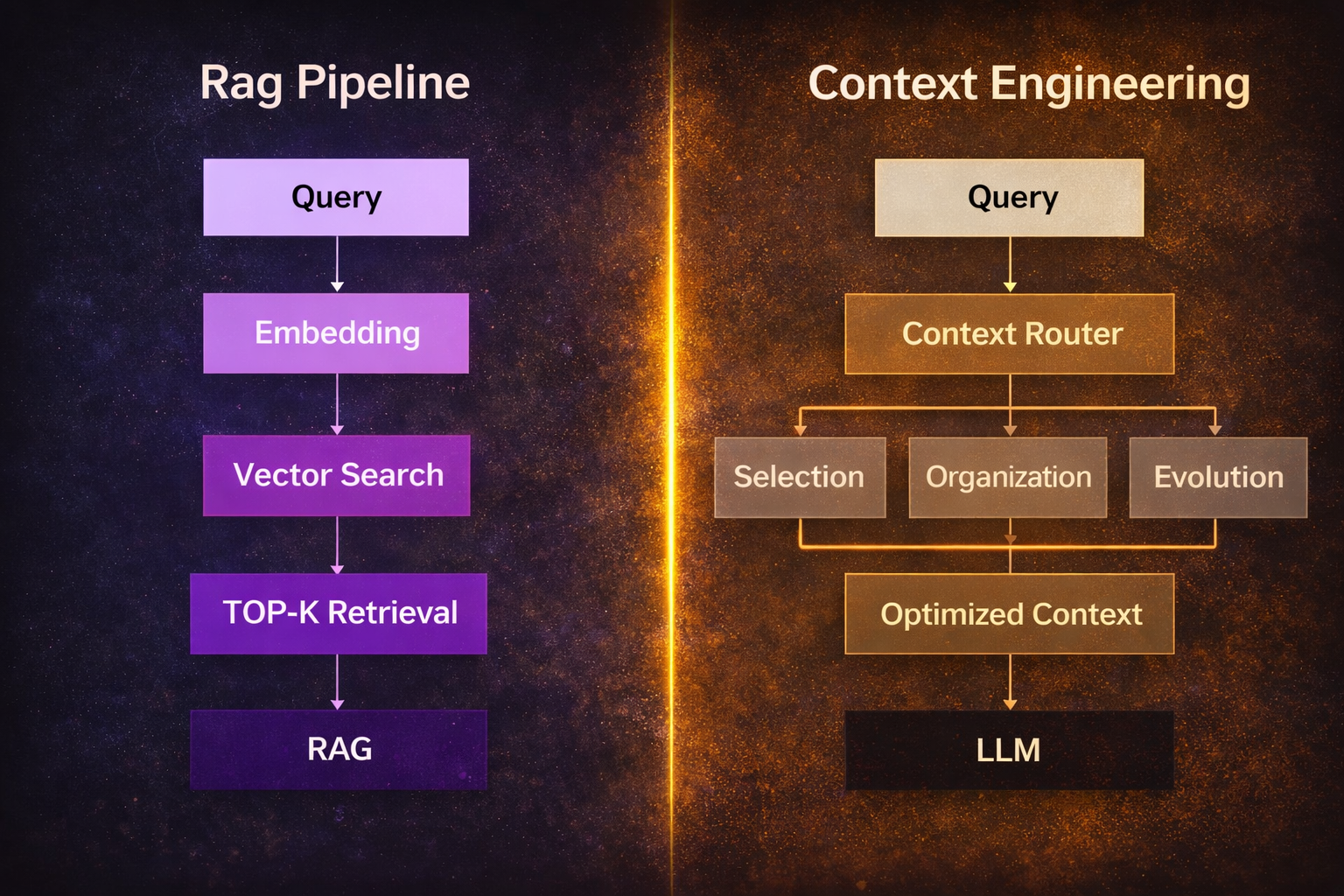
Context Engineering Visual RAG vs. Context Engineering (img2.png)
Context
Diagram comparing RAG versus broader context engineering
RAG is often a subset of context engineering: it retrieves evidence. Context engineering also includes state, tool contracts, policies, memory, and token budgeting—the full “operating envelope.”
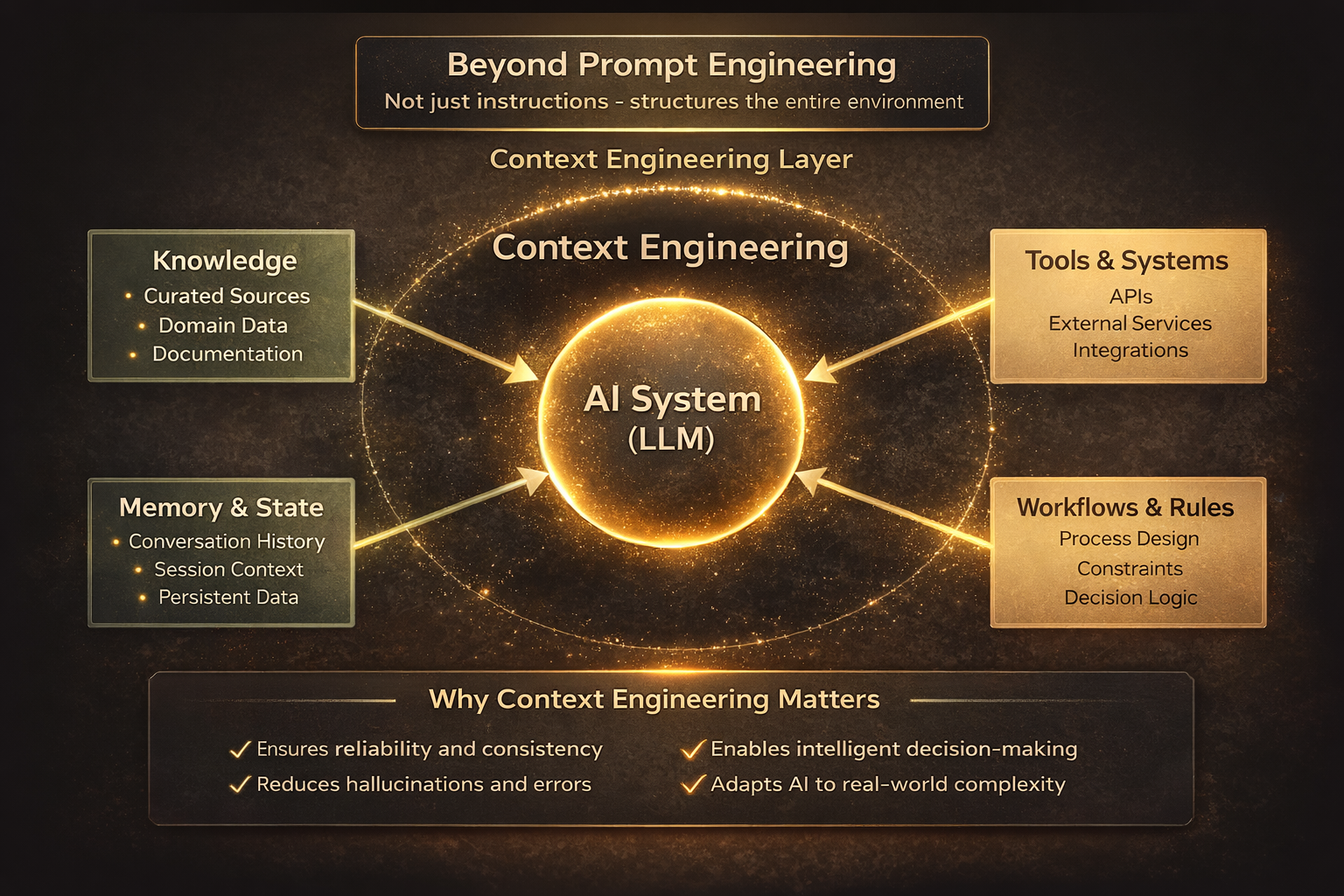
Context Engineering Visual Context Engineering diagram (img3.png)
Context
Diagram illustrating context engineering components and flow
A helpful way to teach this: context engineering is the assembly line that composes the final prompt+context package per request—selecting the right evidence, enforcing constraints, and staying within a budget.
4 — 3 How they are usually designed (a practical blueprint)

3 How they are usually designed (a practical blueprint)

3 How they are usually designed (a practical blueprint)

High-performing agentic systems are built from a small set of reusable design choices. A helpful way to think about it is: you are designing artifacts and a lifecycle.

A) Prompt engineering artifacts (agent-ready)

  • System charter: role, boundaries, safety constraints, refusal rules, tone.
  • Task spec template: objective, inputs, outputs, acceptance criteria.
  • Output contracts: JSON schema, Markdown sections, “must include / must not include.”
  • Few-shot exemplars: minimal, representative, and aligned with the output contract.

B) Context engineering artifacts (production-grade)

  • Retrieval pack: curated sources, embeddings, ranking, filtering, citations/provenance.
  • Tool pack: function definitions, constraints, examples, error-handling expectations.
  • Memory pack: stable user facts, project state, summaries (with freshness rules).
  • Token budget: reserved space for instructions, state, retrieved evidence, output.
Layer What it contains Design goal
System Non-negotiables: safety, role, style, refusal policy. Consistency across all tasks.
Developer Product rules: schemas, tool usage policy, quality bar. Make behavior testable and predictable.
Task context User goal, constraints, acceptance criteria, examples. Reduce ambiguity; define “done.”
Retrieved evidence RAG snippets, documents, tickets, KB pages. Ground the answer in facts.
State + memory Prior steps, partial outputs, user preferences. Continuity and efficiency.
Tool contracts Function schemas, constraints, error patterns. Reliable tool calling.
A design rule that scales
  • Keep prompts stable and move volatility into context (retrieval + state).
  • Version your context packs and run regression tests when they change.
  • Prefer “small + correct” context over “everything and the kitchen sink.”
5 — 4 Examples you can reuse

4 Examples you can reuse

4 Examples you can reuse

Below are agentic-ready templates that show the difference between “prompting” and “engineering the context the agent needs.”

Example 1 — Prompt template for an agentic task

Task prompt (drop-in template) Copy
SYSTEM (stable):
You are an execution-focused AI agent. Follow policies. If missing data blocks correctness, ask for it.
Prefer short, structured outputs. Use tools when needed.

DEVELOPER (stable):
Output must match the requested schema. Cite sources when you use retrieved evidence.
Never invent identifiers, dates, or quotes.

USER / TASK (variable):
Goal: {one sentence objective}
Context: {what the user already decided + constraints}
Inputs: {files, links, data, system state}
Definition of Done:
- {acceptance criterion 1}
- {acceptance criterion 2}
Output format:
- {sections or JSON schema}
Quality checks:
- {e.g., "verify totals", "include assumptions"} 

Example 2 — Context pack for a “budgeting assistant” agent

Context engineering bundle (what you attach alongside the prompt) Copy
CONTEXT PACK (assembled at runtime)
1) Policies
   - Allowed advice scope (finance/legal disclaimers)
   - Safety constraints
2) State
   - User locale, currency, current month, known accounts
   - Last computed budget and assumptions
3) Retrieval (RAG)
   - Relevant policy docs, prior notes, verified rates
   - Each snippet has: source_id, timestamp, excerpt
4) Tools
   - get_transactions(account_id, date_range)
   - categorize_transactions(list)
   - forecast_cashflow(history, horizon)
   - Each tool includes schema + examples + error cases
5) Token budget plan
   - Instructions: 10%
   - State: 15%
   - Retrieval evidence: 35%
   - Working space: 10%
   - Final answer: 30%

Example 3 — Agentic “verify then finalize” pattern

This is a common pattern for making agents more dependable: the model produces a draft, then runs a verification step with explicit checks (often deterministic), and only then finalizes.

Two-pass agent pattern Copy
PASS 1 (Draft):
- Produce output quickly using current context.
- Mark uncertainties explicitly.

PASS 2 (Verify):
- Run checklist:
  • Are required fields present?
  • Are numbers internally consistent?
  • Are claims supported by provided evidence?
  • Did we respect constraints (tone, length, exclusions)?
- If any check fails: retrieve missing context OR ask a targeted question.
- Then produce final output.
Pitfall to avoid
  • Don’t hide critical facts in long retrieved blobs; summarize and cite.
  • Don’t let tool schemas drift—version them and test calls.
  • Don’t treat memory as truth—treat it as hypotheses unless verified.
6 — 5 A quick production checklist

5 A quick production checklist

5 A quick production checklist

Area Checklist item Why it matters
Prompt Clear definition of done + output contract (schema/sections). Prevents “good prose, wrong deliverable.”
Context Retrieval snippets are short, relevant, and carry provenance. Reduces hallucinations and supports audits.
Tools Tool definitions include examples + error handling expectations. Improves tool call reliability and recovery.
Budget Token budgeting is explicit (reserve space for the final answer). Prevents truncation and loss of critical context.
Evaluation Regression tests for prompts + context packs. Changes don’t silently break behavior.
Observability Log what context was supplied and which tools were used. Debuggability and governance.

If you adopt only one habit: treat your context as a first-class engineering artifact—version it, test it, and keep it lean.

7 — 5 A quick production checklist

5 A quick production checklist

5 A quick production checklist

Area Checklist item Why it matters
Prompt Clear definition of done + output contract (schema/sections). Prevents “good prose, wrong deliverable.”
Context Retrieval snippets are short, relevant, and carry provenance. Reduces hallucinations and supports audits.
Tools Tool definitions include examples + error handling expectations. Improves tool call reliability and recovery.
Budget Token budgeting is explicit (reserve space for the final answer). Prevents truncation and loss of critical context.
Evaluation Regression tests for prompts + context packs. Changes don’t silently break behavior.
Observability Log what context was supplied and which tools were used. Debuggability and governance.

If you adopt only one habit: treat your context as a first-class engineering artifact—version it, test it, and keep it lean.

Rate this article

Share your feedback

Optional: send a comment about this article.