Cognitive Creations Strategy · Governance · PMO · Agentic AI

AI Governance Committee & AI Security Framework

A practical, enterprise-grade model for governing and securing AI systems (including agentic workflows), anchored on NIST CSF 2.0 and extended with NIST AI RMF and modern adversarial AI guidance. Includes real-world examples and validated references.

Download as PDF

1 — Executive Summary — From IT Governance to AI Governance (and Why AGSC Must Have “Power to Pause”)

Executive Summary — From IT Governance to AI Governance (and Why AGSC Must Have “Power to Pause”)

Executive Summary — From IT Governance to AI Governance (and Why AGSC Must Have “Power to Pause”)

Before AI, mature organizations learned a critical lesson: technology without governance scales risk faster than it scales value. AI governance is not a new concept—it is governance applied to a more volatile class of technology that introduces probabilistic behavior, emergent outcomes, drift, and delegated decision-making.

One-line leadership statement:
“The AI Governance Steering Committee ensures that AI systems are deployed only when accountability, controls, and risk acceptance are explicit—and retains the authority to pause AI deployments when those conditions are not met.”

1) Governance in the IT World: The Foundation

In mature IT organizations, governance exists to ensure that technology: supports business objectives, operates within risk appetite, meets regulatory and security requirements, and has clear accountability for decisions and outcomes. This is why enterprises established bodies such as IT Steering Committees, Architecture Review Boards (ARBs), Risk & Compliance Committees, and Change Advisory Boards (CABs). These bodies do not build systems—they decide what gets approved, under what conditions, with which controls, and when something must stop.

2) Core Governance Questions (IT → AI)

Every governance model—explicitly or implicitly—answers four questions:

  • Who decides? (authority)
  • What is being decided? (scope)
  • Based on what criteria? (standards, risk, value)
  • What happens if controls are missing or violated? (enforcement)

3) Why AI Requires a Dedicated Governance Body

AI systems—especially agentic and semi/autonomous systems—introduce properties that traditional IT governance was not designed to handle:

  • Probabilistic behavior (not deterministic outputs)
  • Emergent outcomes (not fully predictable interactions)
  • Continuous drift (performance and behavior change over time)
  • Decision delegation (actions move from humans to machines)
  • Blended risk domains (technical + ethical + legal + reputational)
Key difference:
In AI, approval is not a one-time event — it is a lifecycle commitment.

4) AI Governance Steering Committee (AGSC) — Expanded Statement

Establish an AI Governance Steering Committee (AGSC) with explicit decision authority over AI use cases, model and agent approvals, autonomy levels, risk acceptance, and production readiness. The AGSC must operate at the same organizational level as enterprise risk and compliance committees, ensuring AI decisions are governed with the same rigor as financial, cybersecurity, and regulatory risks.

The committee must be empowered to delay, restrict, or pause AI deployments when governance, security, data, or oversight controls are incomplete or ineffective—regardless of delivery pressure or business urgency.

5) What the AGSC Is (and Is Not)

What the AGSC is What the AGSC is not
  • A decision-making body
  • A risk acceptance authority
  • A control enforcement mechanism
  • A cross-functional forum for AI accountability
  • Not a delivery team
  • Not an architecture-only review
  • Not an ethics-only board
  • Not a legal-only checkpoint

Governance fails when it is advisory. Governance works when it has authority.

6) Core Responsibilities of the AGSC (Lifecycle Decisions)

Responsibility What the AGSC decides Evidence expected
Use Case Approval Alignment to strategy, autonomy appropriateness, affected stakeholders understood Intake packet, stakeholder map, tier assignment, intended-use statement
Model / Agent Approval Evaluation completed, data sources approved/classified, guardrails defined Evaluation results, data approvals, tool allowlist, constraints
Risk Acceptance Residual risk within appetite, explicit acceptance owner identified Risk register entry, mitigation status, sign-off record
Production Readiness Monitoring/logging active, kill switch exists, incident response prepared SOC runbook, telemetry proof, rollback plan, kill switch test
Lifecycle Oversight Re-approval cadence, drift/performance reviews, incident-driven reassessment Review calendar, drift dashboards, post-incident actions

7) Core Principles of an AI Governance Framework

An effective AI Governance Framework rests on six core principles consistent with NIST AI RMF, enterprise risk management, and real-world practice:

Principle Meaning in practice
1. Clear Accountability Every AI system has a named business owner, technical owner, and risk owner. Shared ownership creates gaps.
2. Proportional Governance Governance intensity scales with autonomy level, impact severity, and regulatory exposure. One-size-fits-all fails.
3. Human Authority Over AI Humans remain accountable; escalation paths exist; override mechanisms are available. AI may act, but humans own outcomes.
4. Lifecycle Governance Approval is continuous. Controls are revalidated due to drift, model updates, expanded permissions, and new integrations.
5. Transparency & Auditability Systems are explainable enough to govern; logged enough to investigate; traceable to decisions and actions.
6. Enforceability Over Documentation Policies alone do not govern AI. Controls must be enforceable through platforms, workflows, and authority (pause/stop).

8) Why “Power to Pause” Is Critical

The ability to pause or stop deployments is not optional. Without it, risk exceptions accumulate silently, temporary workarounds become permanent, and autonomy grows faster than controls. With it, governance becomes credible and teams design for compliance upfront—enabling AI to scale sustainably.
Bottom line:
The moment governance cannot stop a deployment, it ceases to be governance.
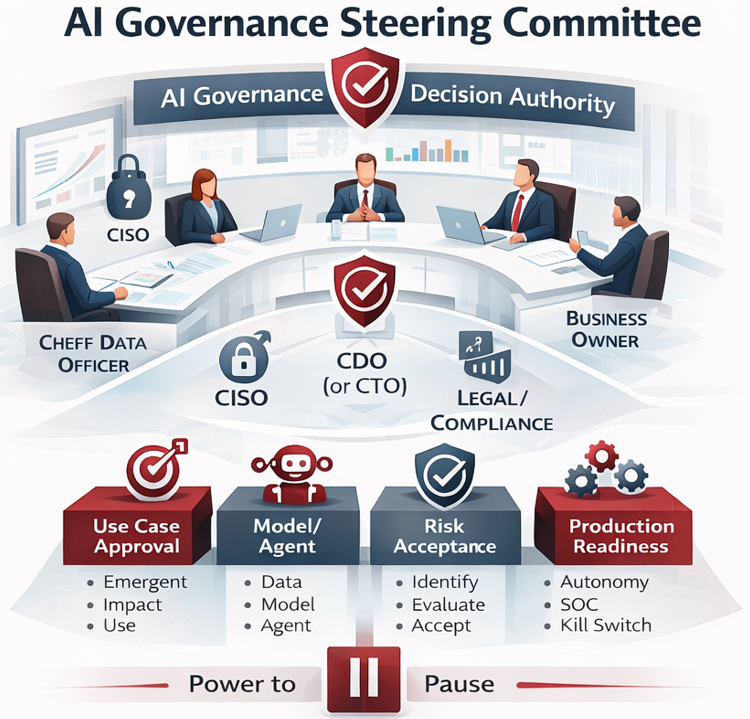
AI Governance Steering Committee: decision authority, lifecycle controls, and power to pause (optional visual)

Figure — AGSC Governance Authority & “Power to Pause”

This diagram reinforces the executive message: AI governance is a decision system (not a delivery team) that approves use cases, validates controls across the lifecycle, accepts residual risk explicitly, and retains the authority to pause deployments when safeguards are incomplete.

AI Autonomy Tiers & Governance Requirements

AI systems should not be governed uniformly. Governance strength must scale with the level of autonomy and the potential impact of failure. The following model defines five autonomy tiers and the corresponding governance controls required to operate them safely and responsibly.
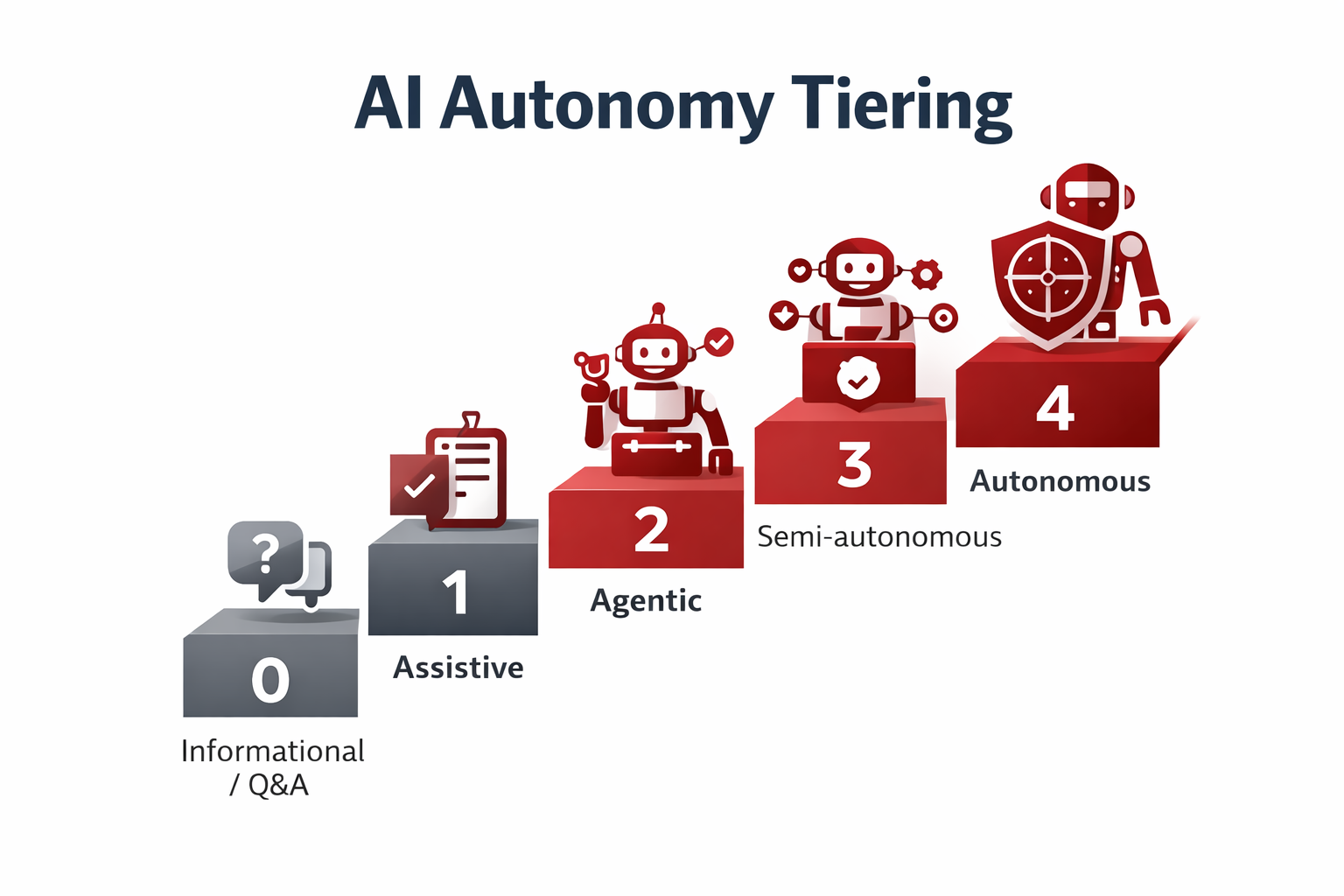
AI Autonomy Tiering (Tier 0–4)

Figure — Autonomy Tiering (Tier 0 → Tier 4)

Use tiering to standardize governance: each step up increases authority, tool access, and potential impact. This creates predictable approval gates, stronger “least privilege” boundaries, and clearer expectations for human oversight before any agent is allowed to take actions (especially Tier 2+).

Guiding principle:
Higher autonomy increases risk. Governance must escalate accordingly to maintain accountability, safety, and auditability.
Tier Autonomy level What the agent does Required governance controls
0 Informational / Q&A Provides information or explanations only. No tool usage, no system actions, and no data writes. Content accuracy standards, approved knowledge sources, disclaimers, lightweight logging, and periodic content review.
1 Assistive Drafts, summarizes, or recommends content while a human remains the final decision-maker. Human-in-the-loop validation, data access approval, prompt/output guardrails, audit logs, and clear business ownership.
2 Agentic Uses tools and retrieves data to perform scoped actions within predefined permissions and constraints. Formal use-case approval, least-privilege access, tool allowlists, continuous monitoring, kill switch, and threat modeling (e.g., MITRE ATLAS).
3 Semi-Autonomous Executes actions independently within defined limits, thresholds, and escalation rules. Executive approval (AGSC), autonomy boundaries, SOC monitoring, incident response playbooks, audits, and residual risk acceptance.
4 Autonomous Operates end-to-end with minimal or no human intervention, making and executing decisions independently. Board-level oversight, continuous real-time monitoring, hard kill switch, independent validation, external audits, and explicit risk acceptance. Often restricted or prohibited.

Leadership takeaway

AI Governance is not about limiting innovation. It is about ensuring that accountability, controls, and oversight increase in proportion to autonomy and risk. Organizations that scale AI safely treat autonomy as a governance decision, not just a technical feature.

1) AI Governance Committee (AGSC)

Establish an AI Governance Steering Committee with decision authority for AI use cases, model/agent approvals, risk acceptance, and production readiness. The AGSC should sit at the same level as enterprise risk committees, and be empowered to pause deployments when controls are incomplete.

Real-world example:
A bank deploying an “AI Relationship Manager” often starts as assistive (drafting summaries), then evolves to agentic (triggering follow-ups). Without an AGSC, autonomy grows informally and new data access gets added “just to make it work,” increasing exposure. A formal committee forces: data classification, human owner assignment, and a kill-switch before scaling.

2) Membership & decision rights

Role Primary responsibilities Decision rights
Executive Sponsor (CIO/CDO/CTO) Strategic alignment, investment decisions, escalation authority Go/No-go funding
CISO / Security Architecture Threat modeling, access control, SOC integration, incident response readiness Security sign-off
Legal + Compliance (GRC) Regulatory mapping, policy controls, vendor terms, audit readiness Compliance sign-off
Data Governance / Privacy Officer Data classification, minimization, retention, privacy impact assessments Data access approval
AI/ML Lead / Platform Owner Model selection, evaluation, guardrails, autonomy tiering Tech design approval
Risk Management (ERM) Risk appetite, impact scoring, residual-risk acceptance process Risk acceptance
Business Owner Use-case ownership, KPI success criteria, human-in-the-loop validation Operational sign-off
HR / Change Mgmt Training, role impact, adoption measurement, workforce enablement Training readiness

Tip: keep the AGSC small and empowered. Use “on-demand” members (Internal Audit, Procurement, Product Safety, etc.) for specific reviews.

3) Operating model (minimum viable governance)

  • Meet monthly during rollout; quarterly when stable.
  • Require a named human owner for each agent and workflow (“accountability anchor”).
  • Classify autonomy: Assistive → Agentic (tool use) → Semi-autonomous → Autonomous (rare; high controls).
  • Approve: data sources, permissions, tool catalog, output guardrails, logging, fallback modes.
  • Authorize: “kill switch” and rollback plan before production.
  • Run post-incident reviews and mandate control improvements.
Autonomy tiering (example) - Tier 0: Informational / Q&A (no tools, no data write) - Tier 1: Assistive (drafting, summarizing, human approves) - Tier 2: Agentic (read tools + retrieval; limited actions) - Tier 3: Semi-autonomous (actions with approvals + constraints) - Tier 4: Autonomous (restricted; continuous monitoring; high assurance)
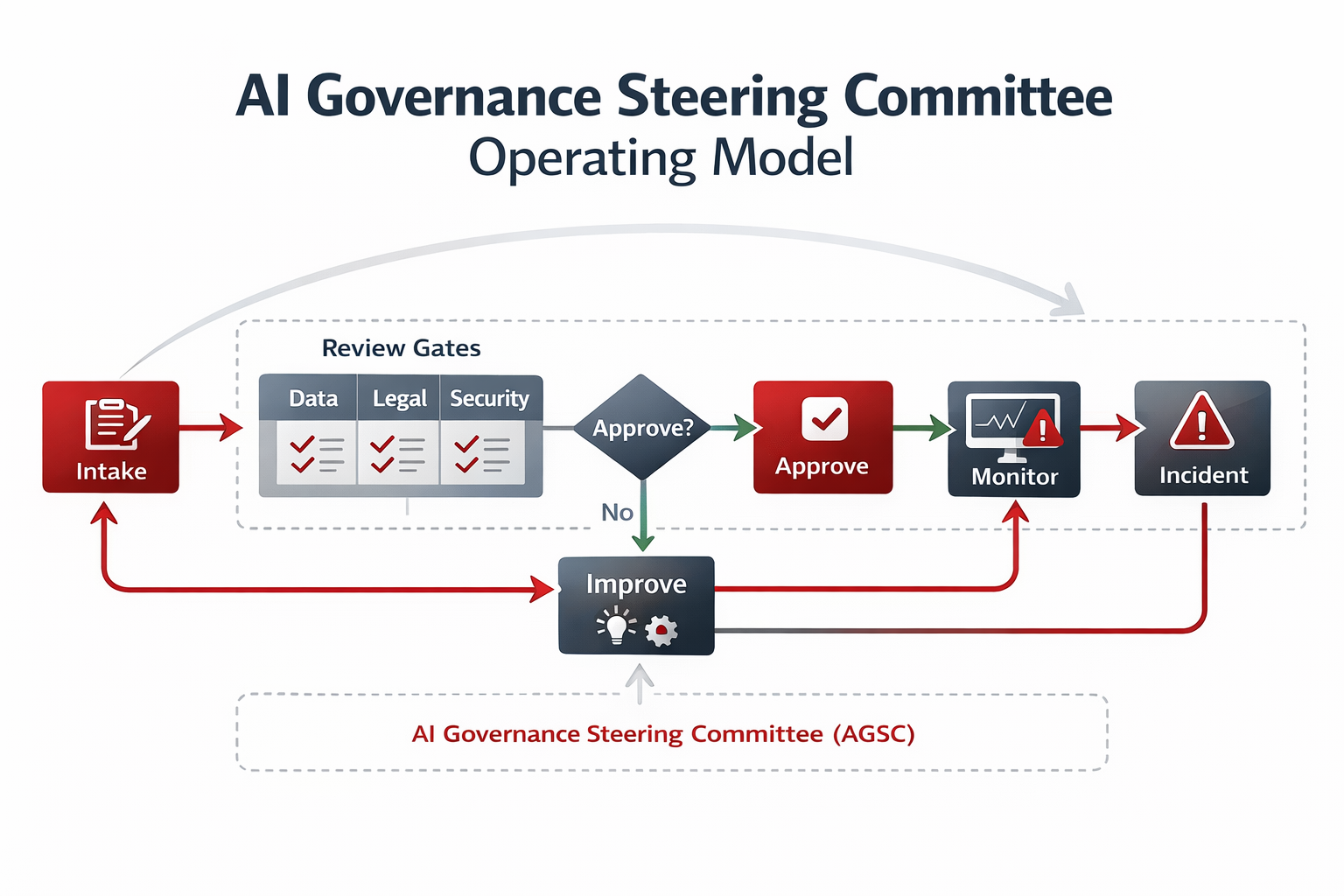
AI Governance Steering Committee Operating Model flowchart

Figure — AGSC Governance Flow (Intake → Gates → Approve → Monitor → Improve)

This flow illustrates the minimum viable governance loop for AI and agentic systems: start with structured intake, route through data/privacy/security/legal gates, approve under explicit autonomy limits, then monitor for drift, anomalies, and policy violations. Incidents feed directly into post-mortems and control upgrades.

Executive takeaway

The most reliable pattern across industries is a governance body with real authority + a security framework stack that covers classic cyber controls and AI-specific risks (bias, hallucination, prompt injection, and model integrity).

One-line recommendation:
“Anchor agent deployments on NIST CSF 2.0 and extend with NIST AI RMF, using adversarial AI threat modeling (e.g., MITRE ATLAS) for red-team and SOC operations.”

What “good” looks like in practice

  • Inventory: Every agent is registered with owner, purpose, data sources, and permissions.
  • Least privilege: Agent can only read/write what the task requires (time-bound tokens where possible).
  • DLP + privacy: PII/PHI redaction, blocklists, and secure prompt handling.
  • Monitoring: Model & tool calls logged; anomaly alerts to the SOC.
  • Fallback: Manual process or “safe mode” if the agent misbehaves.

Quick examples by domain

Use these as “story prompts” when students write leadership memos.

  • Healthcare: Agent summarizes claims → strict PHI controls + audit logs + human review.
  • Finance: Agent drafts client emails → DLP + banned data types + approvals before sending.
  • HR: Agent screens candidates → bias testing + restricted access to sensitive attributes.
  • Customer service: Agent refunds → tool constraints (refund caps) + escalation policy.
2 — Executive Summary — From IT Governance to AI Governance (and Why AGSC Must Have “Power to Pause”)

Executive Summary — From IT Governance to AI Governance (and Why AGSC Must Have “Power to Pause”)

Executive Summary — From IT Governance to AI Governance (and Why AGSC Must Have “Power to Pause”)

Before AI, mature organizations learned a critical lesson: technology without governance scales risk faster than it scales value. AI governance is not a new concept—it is governance applied to a more volatile class of technology that introduces probabilistic behavior, emergent outcomes, drift, and delegated decision-making.

One-line leadership statement:
“The AI Governance Steering Committee ensures that AI systems are deployed only when accountability, controls, and risk acceptance are explicit—and retains the authority to pause AI deployments when those conditions are not met.”

1) Governance in the IT World: The Foundation

In mature IT organizations, governance exists to ensure that technology: supports business objectives, operates within risk appetite, meets regulatory and security requirements, and has clear accountability for decisions and outcomes. This is why enterprises established bodies such as IT Steering Committees, Architecture Review Boards (ARBs), Risk & Compliance Committees, and Change Advisory Boards (CABs). These bodies do not build systems—they decide what gets approved, under what conditions, with which controls, and when something must stop.

2) Core Governance Questions (IT → AI)

Every governance model—explicitly or implicitly—answers four questions:

  • Who decides? (authority)
  • What is being decided? (scope)
  • Based on what criteria? (standards, risk, value)
  • What happens if controls are missing or violated? (enforcement)

3) Why AI Requires a Dedicated Governance Body

AI systems—especially agentic and semi/autonomous systems—introduce properties that traditional IT governance was not designed to handle:

  • Probabilistic behavior (not deterministic outputs)
  • Emergent outcomes (not fully predictable interactions)
  • Continuous drift (performance and behavior change over time)
  • Decision delegation (actions move from humans to machines)
  • Blended risk domains (technical + ethical + legal + reputational)
Key difference:
In AI, approval is not a one-time event — it is a lifecycle commitment.

4) AI Governance Steering Committee (AGSC) — Expanded Statement

Establish an AI Governance Steering Committee (AGSC) with explicit decision authority over AI use cases, model and agent approvals, autonomy levels, risk acceptance, and production readiness. The AGSC must operate at the same organizational level as enterprise risk and compliance committees, ensuring AI decisions are governed with the same rigor as financial, cybersecurity, and regulatory risks.

The committee must be empowered to delay, restrict, or pause AI deployments when governance, security, data, or oversight controls are incomplete or ineffective—regardless of delivery pressure or business urgency.

5) What the AGSC Is (and Is Not)

What the AGSC is What the AGSC is not
  • A decision-making body
  • A risk acceptance authority
  • A control enforcement mechanism
  • A cross-functional forum for AI accountability
  • Not a delivery team
  • Not an architecture-only review
  • Not an ethics-only board
  • Not a legal-only checkpoint

Governance fails when it is advisory. Governance works when it has authority.

6) Core Responsibilities of the AGSC (Lifecycle Decisions)

Responsibility What the AGSC decides Evidence expected
Use Case Approval Alignment to strategy, autonomy appropriateness, affected stakeholders understood Intake packet, stakeholder map, tier assignment, intended-use statement
Model / Agent Approval Evaluation completed, data sources approved/classified, guardrails defined Evaluation results, data approvals, tool allowlist, constraints
Risk Acceptance Residual risk within appetite, explicit acceptance owner identified Risk register entry, mitigation status, sign-off record
Production Readiness Monitoring/logging active, kill switch exists, incident response prepared SOC runbook, telemetry proof, rollback plan, kill switch test
Lifecycle Oversight Re-approval cadence, drift/performance reviews, incident-driven reassessment Review calendar, drift dashboards, post-incident actions

7) Core Principles of an AI Governance Framework

An effective AI Governance Framework rests on six core principles consistent with NIST AI RMF, enterprise risk management, and real-world practice:

Principle Meaning in practice
1. Clear Accountability Every AI system has a named business owner, technical owner, and risk owner. Shared ownership creates gaps.
2. Proportional Governance Governance intensity scales with autonomy level, impact severity, and regulatory exposure. One-size-fits-all fails.
3. Human Authority Over AI Humans remain accountable; escalation paths exist; override mechanisms are available. AI may act, but humans own outcomes.
4. Lifecycle Governance Approval is continuous. Controls are revalidated due to drift, model updates, expanded permissions, and new integrations.
5. Transparency & Auditability Systems are explainable enough to govern; logged enough to investigate; traceable to decisions and actions.
6. Enforceability Over Documentation Policies alone do not govern AI. Controls must be enforceable through platforms, workflows, and authority (pause/stop).

8) Why “Power to Pause” Is Critical

The ability to pause or stop deployments is not optional. Without it, risk exceptions accumulate silently, temporary workarounds become permanent, and autonomy grows faster than controls. With it, governance becomes credible and teams design for compliance upfront—enabling AI to scale sustainably.

Bottom line:
The moment governance cannot stop a deployment, it ceases to be governance.
AI Governance Steering Committee: decision authority, lifecycle controls, and power to pause (optional visual)

Figure — AGSC Governance Authority & “Power to Pause”

This diagram reinforces the executive message: AI governance is a decision system (not a delivery team) that approves use cases, validates controls across the lifecycle, accepts residual risk explicitly, and retains the authority to pause deployments when safeguards are incomplete.

3 — AI Autonomy Tiers & Governance Requirements

AI Autonomy Tiers & Governance Requirements

AI Autonomy Tiers & Governance Requirements

AI systems should not be governed uniformly. Governance strength must scale with the level of autonomy and the potential impact of failure. The following model defines five autonomy tiers and the corresponding governance controls required to operate them safely and responsibly.

AI Autonomy Tiering (Tier 0–4)

Figure — Autonomy Tiering (Tier 0 → Tier 4)

Use tiering to standardize governance: each step up increases authority, tool access, and potential impact. This creates predictable approval gates, stronger “least privilege” boundaries, and clearer expectations for human oversight before any agent is allowed to take actions (especially Tier 2+).

Guiding principle:
Higher autonomy increases risk. Governance must escalate accordingly to maintain accountability, safety, and auditability.
Tier Autonomy level What the agent does Required governance controls
0 Informational / Q&A Provides information or explanations only. No tool usage, no system actions, and no data writes. Content accuracy standards, approved knowledge sources, disclaimers, lightweight logging, and periodic content review.
1 Assistive Drafts, summarizes, or recommends content while a human remains the final decision-maker. Human-in-the-loop validation, data access approval, prompt/output guardrails, audit logs, and clear business ownership.
2 Agentic Uses tools and retrieves data to perform scoped actions within predefined permissions and constraints. Formal use-case approval, least-privilege access, tool allowlists, continuous monitoring, kill switch, and threat modeling (e.g., MITRE ATLAS).
3 Semi-Autonomous Executes actions independently within defined limits, thresholds, and escalation rules. Executive approval (AGSC), autonomy boundaries, SOC monitoring, incident response playbooks, audits, and residual risk acceptance.
4 Autonomous Operates end-to-end with minimal or no human intervention, making and executing decisions independently. Board-level oversight, continuous real-time monitoring, hard kill switch, independent validation, external audits, and explicit risk acceptance. Often restricted or prohibited.

Leadership takeaway

AI Governance is not about limiting innovation. It is about ensuring that accountability, controls, and oversight increase in proportion to autonomy and risk. Organizations that scale AI safely treat autonomy as a governance decision, not just a technical feature.

4 — 4) Recommended AI Security & Governance Framework Stack

4) Recommended AI Security & Governance Framework Stack

4) Recommended AI Security & Governance Framework Stack

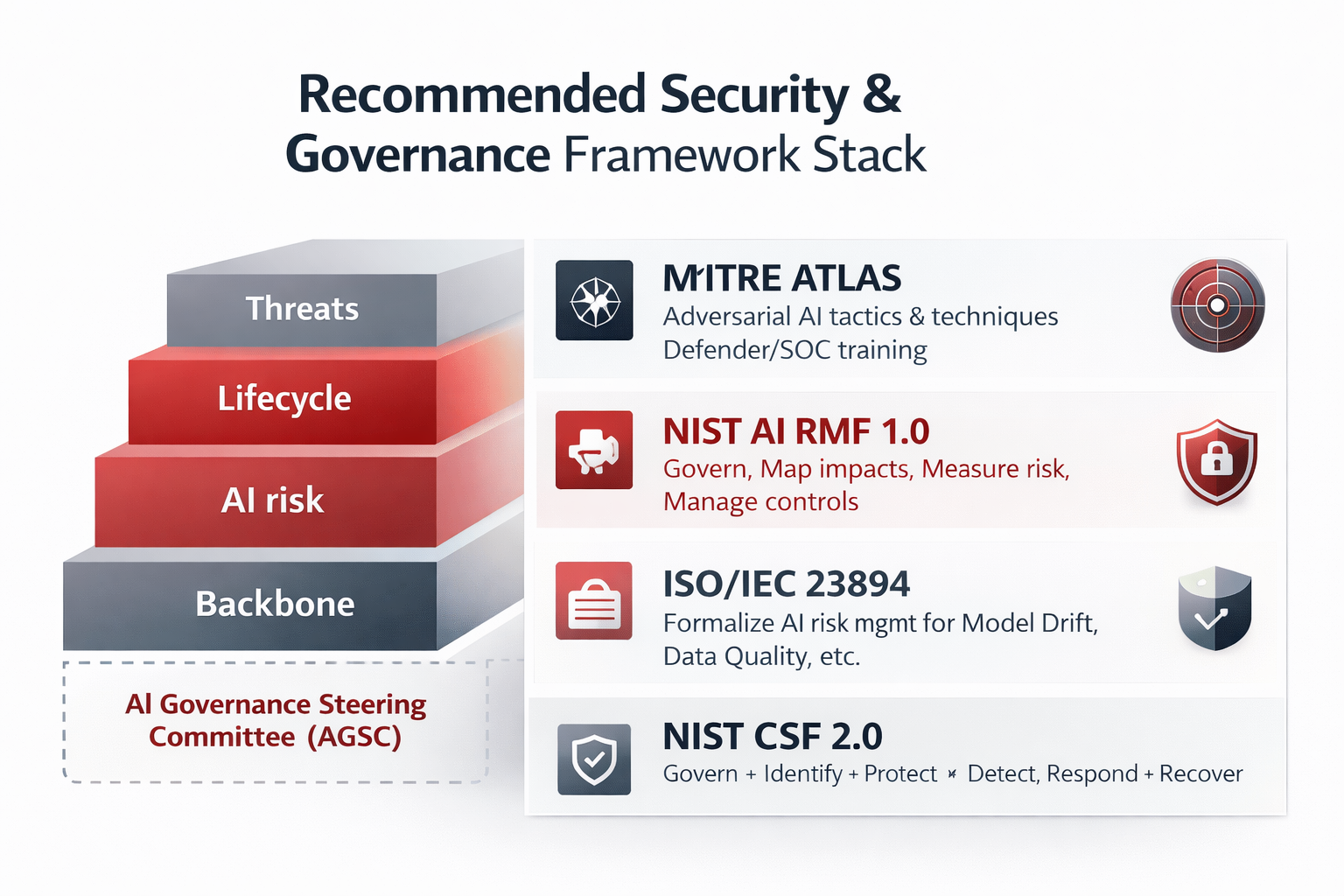
For a complete and defensible program, use a layered approach: NIST CSF 2.0 as the cybersecurity backbone, NIST AI RMF for AI-specific trustworthiness and risk, and ISO/IEC 23894 for lifecycle AI risk management practices (particularly useful for global orgs). For threat modeling and red-teaming, add MITRE ATLAS.

Recommended Security & Governance Framework Stack infographic

Figure — Layered Framework Stack (CSF 2.0 + AI RMF + ISO 23894 + MITRE ATLAS)

This “stack” avoids the common gap where teams do either cybersecurity or AI ethics. CSF 2.0 provides the cyber backbone (Protect/Detect/Respond/Recover), AI RMF makes trustworthiness measurable (Govern/Map/Measure/Manage), ISO 23894 strengthens lifecycle risk integration, and MITRE ATLAS makes adversarial AI threats concrete for red-teaming and SOC playbooks.

Layer Framework What it gives you (with example)
Backbone NIST CSF 2.0 Classic cyber lifecycle (Govern, Identify, Protect, Detect, Respond, Recover).
Example: define SOC alerts + containment playbook for agent anomalies.
AI risk NIST AI RMF 1.0 Trustworthy AI practices (governance, mapping impacts, measuring risk, managing controls).
Example: bias/robustness testing and human oversight expectations.
Lifecycle ISO/IEC 23894 AI risk management guidance integrated into organizational risk processes.
Example: formal risk treatment plans for model drift and data quality.
Threats MITRE ATLAS Adversarial AI tactics/techniques knowledge base to drive red-team and SOC playbooks.
Example: prompt injection scenarios mapped to mitigations and detection.

5) Control model (what to implement)

A simple and effective implementation pattern is a three-layer control stack that connects governance, technical safeguards, and operational readiness.

Layer Controls Real-world example
Governance AI registry, data approval, autonomy tiering, RACI, risk acceptance Agent cannot access HR/Finance data until Data + Legal approve classification and scope.
Technical RBAC/Zero Trust, secrets mgmt, DLP, prompt guardrails, sandboxing Customer service agent can issue refunds only up to $50 and only via approved tool call.
Operations Telemetry, anomaly detection, SOC runbooks, tabletop exercises, rollback If model starts leaking PII, SOC triggers kill switch and comms template goes live.
5 — NIST AI RMF Playbook — Practical integration into Governance

NIST AI RMF Playbook — Practical integration into Governance

NIST AI RMF Playbook — Practical integration into Governance

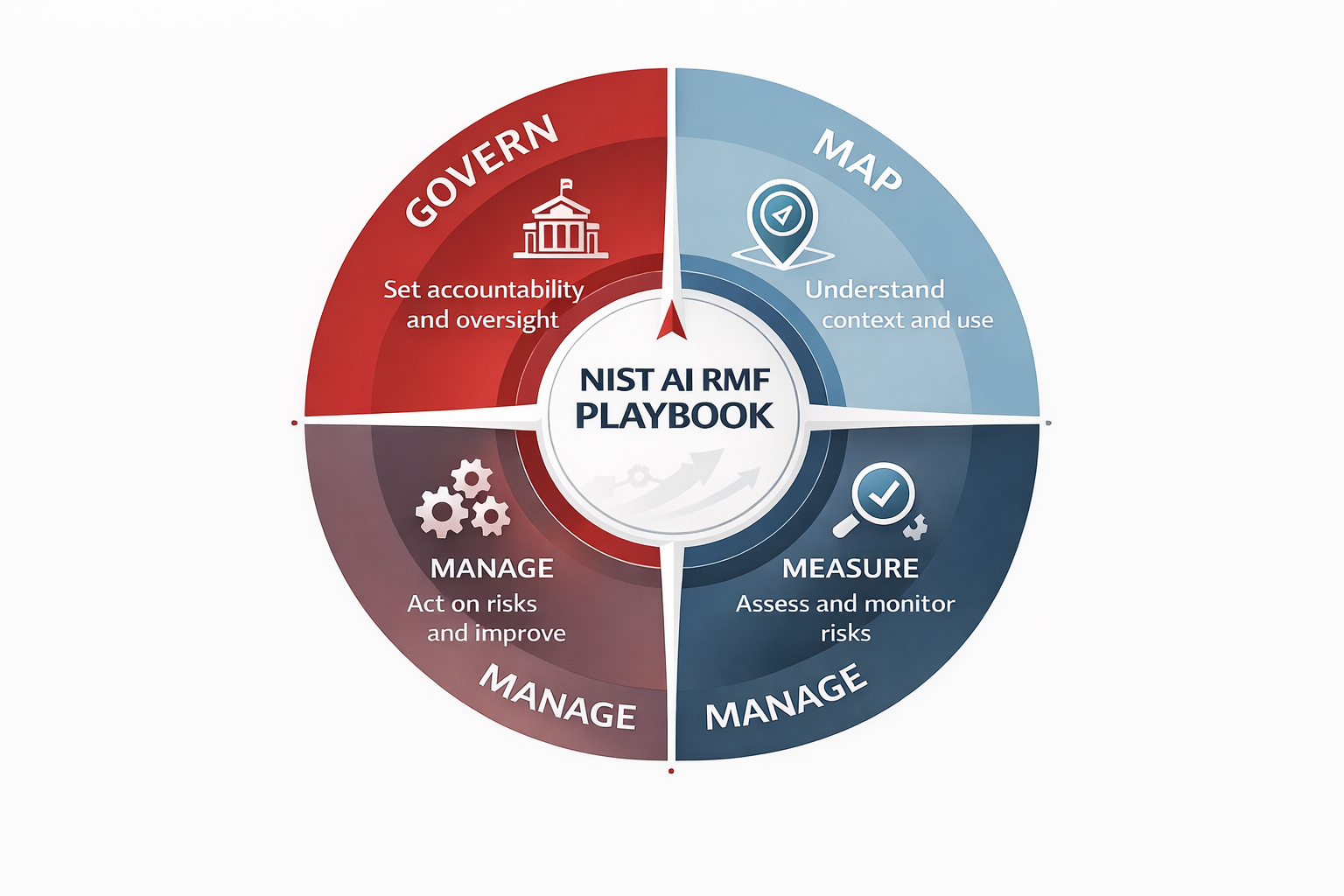
A practical, voluntary implementation guide that helps organizations operationalize the NIST AI RMF 1.0 across the entire AI lifecycle. It is not a checklist, but a set of actionable practices that organizations can selectively adopt based on risk profile, maturity, and use cases.

NIST AI RMF Playbook: Govern, Map, Measure, Manage

Figure — AI RMF Playbook Compass (GOVERN • MAP • MEASURE • MANAGE)

Use this compass as a governance “routing map”: GOVERN defines roles, policies, and accountability; MAP clarifies purpose, context, and stakeholders; MEASURE produces evidence through tests and monitoring; and MANAGE turns findings into mitigation, response, and continuous improvement decisions.

One-sentence takeaway:
The AI RMF Playbook translates trustworthy AI from principles into day-to-day governance, risk, and operational practices—without prescribing a one-size-fits-all solution.

How the Playbook fits your committee model

  • GOVERN aligns with the AGSC: decision rights, accountability, escalation paths, and policy enforcement.
  • MAP strengthens intake: document purpose, context, stakeholders, and potential harms before autonomy expands.
  • MEASURE formalizes assurance: define metrics for bias, robustness, drift, and monitoring that the SOC can act on.
  • MANAGE turns findings into action: mitigation plans, incident response, change management, and stop/retire decisions.

What each function emphasizes

Function Focus Typical actions
GOVERN Set accountability and oversight Policies, roles, approvals, human oversight models, documentation, impact assessments
MAP Understand context and intended use Purpose, assumptions, stakeholders, affected groups, misuse/edge cases, human-AI interactions
MEASURE Assess and monitor risks Bias/robustness checks, uncertainty, drift monitoring, logging, audit trails, incident metrics
MANAGE Act on risks and improve Mitigation plans, response, change/version controls, rollback, pause/retire decisions, lessons learned

Cross-cutting emphasis: human accountability, transparency and documentation, socio-technical thinking, inclusivity/fairness, lifecycle-based risk management.

6 — MITRE ATLAS — Friendly, practical guide for AI threat modeling

MITRE ATLAS — Friendly, practical guide for AI threat modeling

MITRE ATLAS — Friendly, practical guide for AI threat modeling

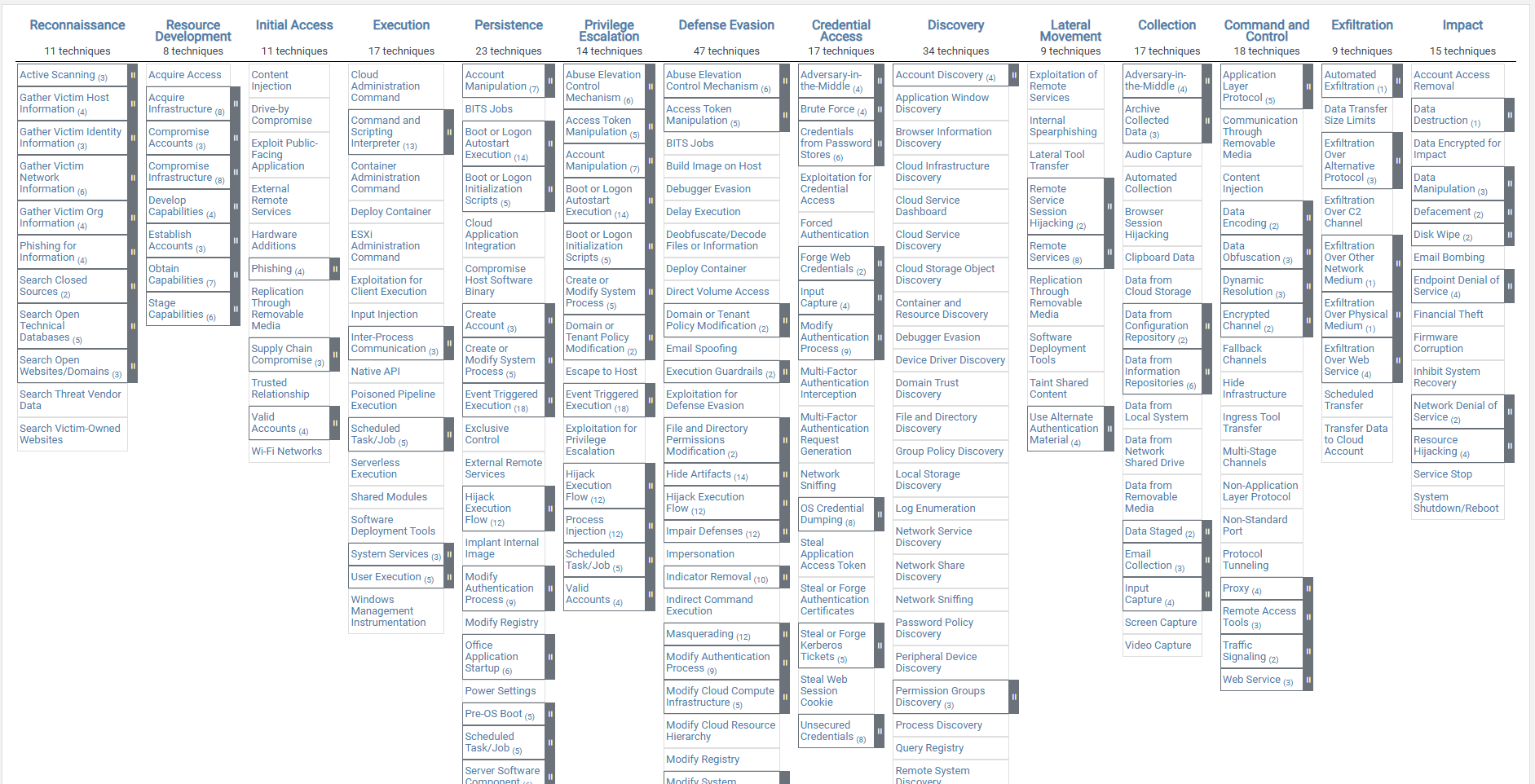
MITRE ATLAS (Adversarial Threat Landscape for AI Systems) is a globally accessible, living knowledge base of adversary tactics and techniques based on real-world attack observations and realistic demonstrations from AI red teams and security groups.

MITRE ATLAS overview: tactics & techniques mapped across the AI lifecycle (optional visual)

Figure — MITRE ATLAS as “ATT&CK for AI” (Tactics → Techniques)

This visual helps non-security stakeholders quickly understand how ATLAS works: tactics are attacker objectives (the “why”), techniques are concrete methods (the “how”). Use it to design red-team scenarios and to translate AI risks into SOC-ready detections and runbooks.

Why ATLAS matters for agentic AI

  • It turns “AI security concerns” into concrete scenarios your red team and SOC can test (prompt injection, data leakage, abuse of tools, model extraction).
  • It expands classic cyber threat modeling to AI-specific surfaces (training data, inference behavior, prompt context, tool-calling workflows).
  • It supports governance decisions by linking threats to mitigations and required monitoring evidence before production approval.

Common ATLAS-aligned threat buckets (plain-English)

Threat bucket What it looks like Control examples (aligned to your framework)
Prompt injection & tool abuse Malicious content overrides instructions; agent performs unsafe actions or exfiltrates data via tools. Tool allowlists, constrained actions, input/output filters, sandboxing, human approval gates (Tier 2+), audit logs.
Data poisoning Training/feedback data is manipulated to bias outcomes or embed backdoors. Data provenance, validation checks, access controls for training data, drift monitoring, retraining governance gates.
Model extraction / theft Repeated queries reconstruct model behavior or leak proprietary capabilities. Rate limiting, anomaly detection, watermarking strategies, output restrictions, access tiering.
Privacy leakage Model reveals sensitive info about training data or prompt context. DLP/redaction, blocked data types, secure prompt handling, retention controls, logging + incident triggers.
Adversarial evasion Inputs are crafted to fool classification or decision systems (esp. vision/sensor/ML pipelines). Robustness testing, adversarial evaluation, monitoring for anomalies, fallback modes, human oversight.

How to operationalize ATLAS with NIST AI RMF + CSF 2.0

  • AI RMF “MAP”: Use ATLAS to identify plausible misuse/attack scenarios for each agent and tool workflow.
  • AI RMF “MEASURE”: Build red-team test packs (prompt injection attempts, exfil tests, extraction probes) and define pass/fail evidence.
  • AI RMF “MANAGE”: Convert failures into mitigations, monitoring rules, and formal approvals (or stop/retire decisions).
  • CSF 2.0 Detect/Respond: Map ATLAS-style scenarios into SOC alerts and your runbooks (kill switch triggers, containment steps, comms templates).

Video summary (MITRE ATLAS overview)

Executive summary (what the video explains):
The video uses a “leaky pipe” analogy to explain why AI security requires a structured way to trace an incident back to its source. In cybersecurity—especially for AI-based attacks—you need to understand (1) what kind of attack it is, (2) what the attacker is targeting, and (3) the sequence of steps taken. The video introduces MITRE ATLAS as a framework built for AI attacks, similar in spirit to MITRE ATT&CK, providing a practical timeline and common language for describing adversarial behavior.

Key points highlighted in the video

  • Root-cause thinking: don’t “patch the puddle”—trace the upstream source of the failure (same concept applies to AI incidents).
  • Attack understanding drives defense: identify the attack type, attacker target, and the step-by-step path so you can prevent recurrence.
  • ATLAS structure: tactics are the attacker’s “why” (objective) and techniques are the “how” (methods).
  • Navigator + heat maps: ATLAS provides visual ways to show which techniques were used (breadcrumb trail) and where risk concentrates.
  • Why it matters: AI attacks are already costly and will grow as AI adoption increases across use cases.

Case study summary (malware scanner ML bypass)

The video walks through a real ATLAS case study showing how attackers can exploit ML decision logic to evade detection.

Stage What the attacker did Defensive implication
Recon Collected public information (talks, publications, videos) and patents/IP to understand the system. Assume public artifacts can be weaponized; control sensitive details and design for resilience anyway.
Model access Studied the product behavior; enabled verbose logging; learned how reputation scoring likely worked. Harden logging exposure; treat “debug output” as potential leakage; segment attacker-visible signals.
Resource development Reverse engineered features/attributes used for detection and uncovered a second “override model.” Document model ensembles; test interactions between models; validate override logic under adversarial inputs.
Attack staging Manually modified malware and appended benign-looking content to trigger the override behavior. Run adversarial testing against “append/overlay” strategies; add anomaly rules for suspicious benign padding.
Impact Defense evasion: the scanner misclassified malicious code as safe. Require monitoring + fallback modes; treat misclassifications as incidents with defined runbooks.

How to use the video’s approach in your program

  • Governance: require that every Tier 2+ agent has an “attack path review” (what is the target + likely steps + mitigations).
  • Testing: build a repeatable red-team pack (prompt injection, data leakage, privilege escalation, model behavior probing).
  • Operations: connect model/tool logs to SOC workflows; define triggers that activate safe mode / token revocation / kill switch.
  • Learning loop: use post-incident reviews to update guardrails, monitoring, and approval gates (continuous improvement).

Video reference: https://www.youtube.com/watch?v=QhoG74PDFyc

ATLAS Quickstart (practical) 1) Pick 3 high-risk workflows (Tier 2+ tool use) 2) For each workflow: list 5 adversarial scenarios (prompt injection, exfil, privilege escalation, drift) 3) Define tests + evidence: logs, tool traces, blocked actions, DLP events, approvals 4) Add SOC detections and runbooks (containment + kill switch) 5) Re-test after mitigations; document approval decision (AGSC)
7 — What “good” looks like in practice

What “good” looks like in practice

What “good” looks like in practice

The most reliable pattern across industries is a governance body with real authority + a security framework stack that covers classic cyber controls and AI-specific risks (bias, hallucination, prompt injection, and model integrity).

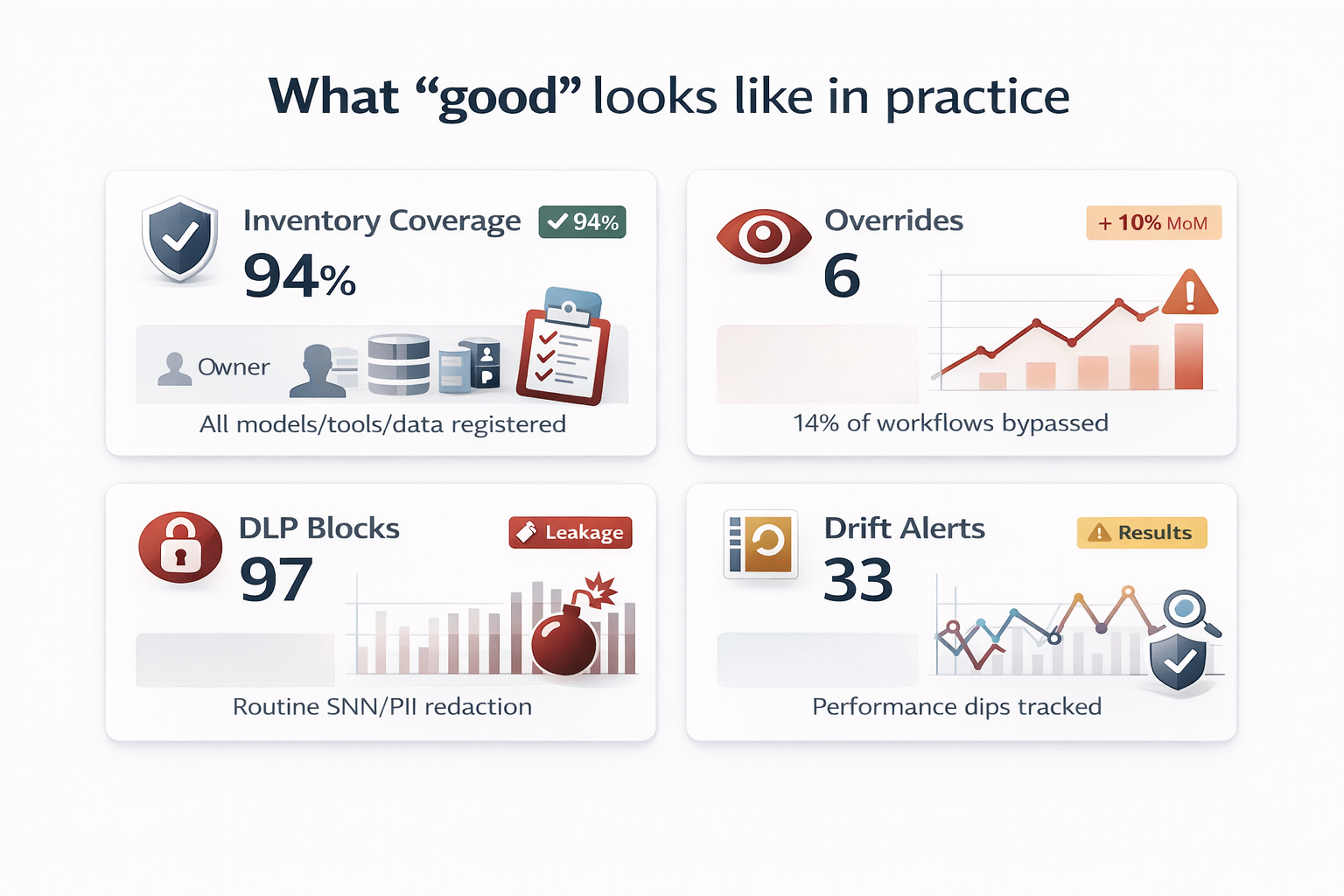
What Good Looks Like dashboard tiles

Figure — “What Good Looks Like” Operational Dashboard

These KPIs help leadership validate that governance is real (not just policy): registry coverage and ownership prove accountability, DLP blocks and PII events reveal data risk exposure, override/escalation rates show how humans are controlling outcomes, and drift/anomaly alerts confirm the system is being monitored as an operational product—especially important for agentic workflows with tool access.

Incident response (AI + agentic workflows)

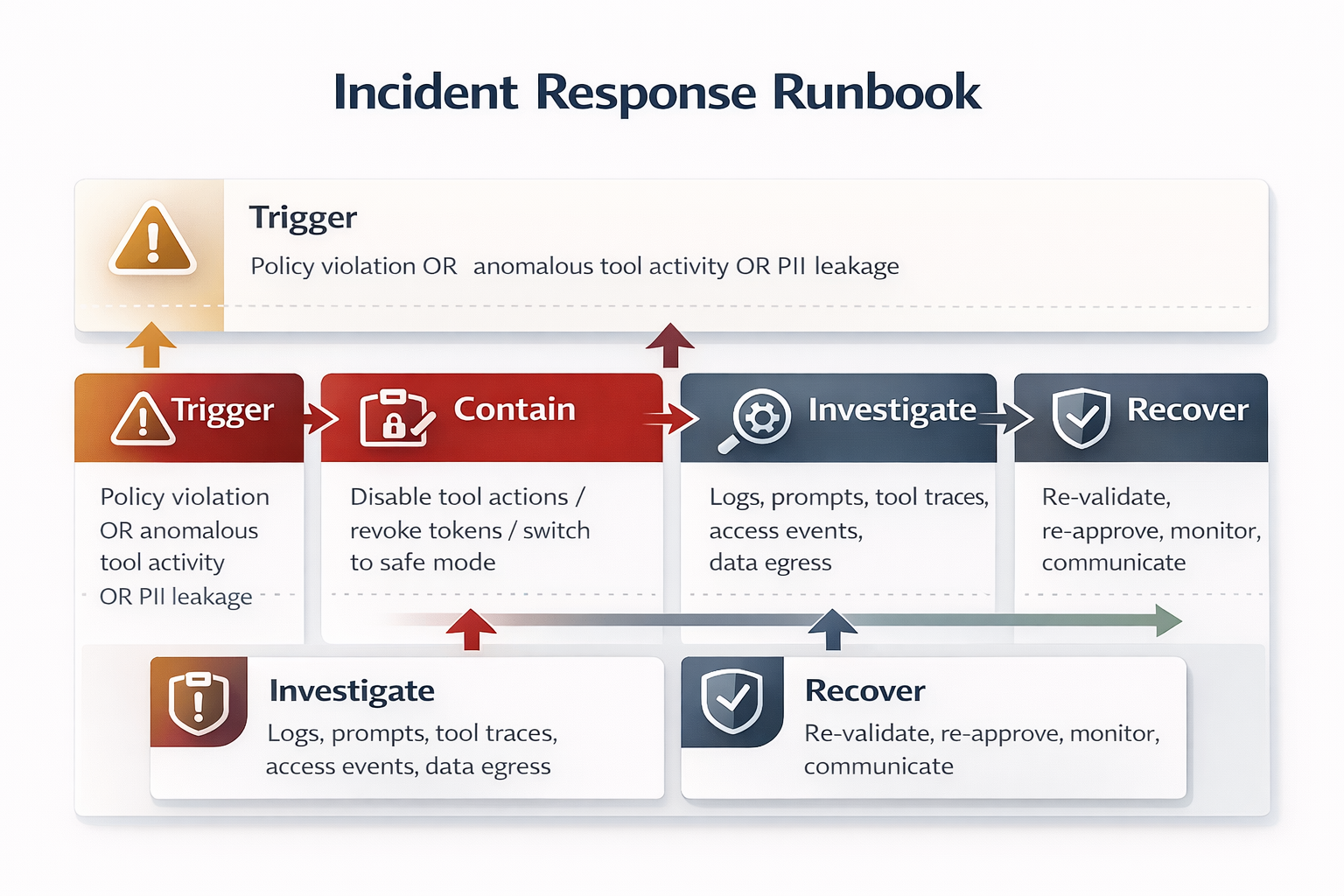
Operationalize containment and recovery through SOC-ready runbooks and tested kill switches.

Incident Response Runbook: Trigger, Contain, Investigate, Remediate, Recover, Learn

Figure — Incident Response Runbook (Trigger → Learn)

This runbook converts AI incidents into repeatable operations: Trigger defines what qualifies as an incident (policy violation, anomalous tool activity, or PII leakage); Contain limits harm through safe mode or token revocation; Investigate uses logs, prompts, tool traces, and data egress signals; Remediate upgrades guardrails and policies; Recover re-validates and re-approves the agent; and Learn mandates improvements through post-incident reviews owned by the AGSC.

6) Training model (role-based, audit-friendly)

“Everyone gets AI training” is not enough. Mature programs use role-based curricula with measurable completion and periodic refreshers (annual minimum + incident-triggered refresh).

Audience Training themes Practical exercise (example)
Executives Risk appetite, accountability, approval gates, incident communications Tabletop: agent causes data leakage → decide public disclosure + business continuity actions.
Business users Capabilities/limits, safe prompting, data handling, validation Exercise: identify hallucinated claims; rewrite prompt with citations requirements.
Engineers Secure tool design, guardrails, evals, red-team testing Lab: prompt injection attempt → implement allowlists + content filters + tool constraints.
SOC/SecOps Adversarial AI threats, detection rules, kill switch triggers Sim: unusual tool-call volume & data egress → contain + isolate + investigate.
Legal/Compliance Regulatory, privacy impact, vendor terms, audit evidence Workshop: define what’s “prohibited data” for AI and how exceptions are approved.

7) Ownership, Leadership & Execution Model for the AI Governance Framework

AI Governance must be treated as an enterprise operating system—not a document. The program succeeds when there is a single accountable owner, clear co-owners for security and compliance, and a practical execution model embedded into product delivery (intake → build → deploy → monitor → improve).

Principle:
“One accountable owner, many contributors.” Governance is cross-functional, but accountability must be unambiguous to prevent gaps, delays, and risk drift as autonomy increases.

7.1 Recommended Ownership (Accountability) Model

Accountability layer Recommended role Why it fits (practical rationale)
Program Owner CDO / CTO / CDTO (or CDAO) AI spans data, platforms, decisioning, and operating models. This role has the enterprise mandate to balance value delivery with risk appetite, set standards, and stop deployments when controls are incomplete.
Security Co-Owner CISO / Security Architecture Owns adversarial AI threat modeling (e.g., MITRE ATLAS), secure tool design, SOC integration, detection and response playbooks, and “kill switch” readiness.
Compliance Co-Owner Legal + Compliance / Privacy / GRC Ensures regulatory mapping, privacy impact controls, vendor terms, audit evidence, and policy enforcement mechanisms are production-ready.
Risk Co-Owner Enterprise Risk Management (ERM) Defines risk appetite, impact scoring, and the residual risk acceptance workflow required for controlled scaling.
Operational Owners Business Owners (per use case) Own day-to-day outcomes: KPI definitions, human oversight, escalation, and maintaining safe operating boundaries for each agent/workflow.
Technical Implementers AI/ML Platform + MLOps + DevSecOps Implement guardrails, evaluation pipelines, access controls, logging, monitoring, and change management to keep governance enforceable.

Tip: Avoid “single-function governance” (security-only, legal-only, or IT-only). It either becomes a bottleneck or it misses key risks.

7.2 Who Designs vs. Who Implements vs. Who Runs (RACI Snapshot)

Work item Design (A/R) Implement (R) Run & Monitor (R)
AI Governance Policy + Standards CDO/CTO + GRC PMO/Digital Office AGSC + Internal Audit
AI Registry (models/agents/data/tools) AI Platform Owner MLOps / Engineering Business Owners + ERM
Autonomy Tiering + Approval Gates CDO/CTO + CISO AI Platform + Product AGSC
Threat Modeling (MITRE ATLAS) CISO / SecArch Red Team / AppSec SOC
Evaluation & Monitoring (drift, bias, anomalies) AI/ML Lead MLOps SOC + Product Ops
Incident Response + Kill Switch CISO / SOC Lead DevSecOps SOC + AGSC

7.3 Reference Implementation Plan (90-Day Pilot → Scale)

This plan is designed for practical execution: start with a controlled pilot, establish audit-grade evidence, and scale only after controls prove effective.

Phase Timeline Key deliverables Evidence / “Definition of Done”
Phase 0: Mobilize Weeks 1–2 AGSC charter; owner assigned; autonomy tier policy; initial risk appetite statement; initial use-case shortlist. Charter approved; meeting cadence set; named owners per use case; tier policy published.
Phase 1: Baseline Controls Weeks 3–6 AI registry v1; data classification rules; tool allowlists; logging requirements; DLP/PII guardrails; vendor/model intake checklist. Registry coverage for pilot; least-privilege access in place; logs captured for model + tool calls; DLP blocks tested.
Phase 2: Assurance & Red Team Weeks 7–10 Evaluation suite (bias/robustness/drift); MITRE ATLAS scenario pack; SOC detections; tabletop exercise; incident runbooks. Test results documented; red-team findings closed or accepted; SOC alerts validated; kill switch tested.
Phase 3: Launch & Scale Weeks 11–13 Production go-live with monitoring; periodic review cadence; training completion tracking; post-launch governance loop. Go-live approval recorded; monitoring dashboards live; training completion ≥ agreed threshold; post-incident review template ready.

7.4 Operating Cadence (Run the Program Like a Product)

  • Monthly (during rollout): AGSC approvals, risk exceptions review, autonomy tier changes, and audit evidence sampling.
  • Quarterly (steady state): policy refresh, KPI review, vendor/model re-validation, and drift/security trend assessment.
  • Per release: change control, evaluation re-run, threat model delta review, and SOC rule validation.
  • Post-incident: mandatory retrospective, control upgrades, and re-approval before restoring autonomy.

7.5 Suggested Visuals to Add (Images You Can Generate)

To keep navigation easy and executive-friendly, visuals should reinforce decision-making: ownership clarity, approval gates, and scale-readiness criteria.

  • Ownership “triangle” diagram: Program Owner (CDO/CTO) + Security Co-owner (CISO) + Compliance Co-owner (GRC) with Business Owners below.
  • 90-day roadmap timeline: Four blocks (Mobilize → Baseline Controls → Assurance/Red Team → Launch & Scale), with outputs per phase.
  • Approval gates swimlane: Business → Data/Privacy → Security → Legal → AGSC decision → Production monitoring.
  • Evidence checklist card set: 6–8 small tiles (Registry, Least Privilege, DLP, Logs, Red Team, Kill Switch, Training, Incident Runbook).
Placement recommendation:
Add this section immediately after “AI Governance Committee (AGSC)” to clarify accountability, then reference the 90-day plan as the operational path to make governance real.

FAQ — AI Governance Framework & AI Security Framework

A practical, executive-friendly FAQ to clarify responsibilities, controls, and how to scale AI (including agentic workflows) safely.

1) What is AI Governance (in one sentence)?

AI Governance is the enterprise decision and control system that ensures AI is deployed only when accountability, risk acceptance, controls, and ongoing oversight are explicit and enforceable.

2) How is AI Governance different from AI Ethics?

AI Ethics focuses on values and principles (fairness, harm prevention, human dignity). AI Governance converts those principles into policies, decision rights, technical guardrails, audit evidence, and enforcement. Ethics without governance remains advisory.

3) Do we really need a dedicated AI Governance Steering Committee (AGSC)?

Yes—especially for Tier 2+ agentic systems—because AI introduces probabilistic behavior, drift, and delegated decisions. Traditional IT boards (ARB/CAB) are not designed to continuously re-approve and monitor AI risk over time.

4) Who should own AI Governance in an organization?

The governance framework should have a single accountable program owner (often CDO/CTO/CDAO/CDTO), with formal co-ownership by CISO (security) and GRC/Privacy (compliance). Each AI system must also have a named business owner, technical owner, and risk owner.

5) What does “Power to Pause” mean, and why is it essential?

“Power to Pause” means the AGSC can delay, restrict, or stop an AI deployment when controls are incomplete, regardless of delivery pressure. Without it, exceptions accumulate, temporary workarounds become permanent, and autonomy grows faster than safeguards.

6) What’s the difference between AI Governance and AI Security?

AI Governance defines who decides, what is approved, under what criteria, and how enforcement works. AI Security implements technical protections (e.g., RBAC, DLP, logging, sandboxing, threat modeling, SOC monitoring) to reduce adversarial and operational risk. Governance is the decision system; security is a core control layer within it.

7) How do autonomy tiers change governance requirements?

Governance intensity must scale with autonomy and impact. Tier 0–1 typically needs lightweight controls and human review. Tier 2+ requires formal approvals, tool allowlists, least privilege, continuous monitoring, incident runbooks, and explicit risk acceptance. Tier 4 is often restricted or prohibited without very high assurance and continuous oversight.

8) What are the “must-have” controls for a Tier 2 (agentic) pilot?

  • AI registry: owner, purpose, data sources, tools, permissions, tier.
  • Least privilege: narrow scopes, time-bound credentials where possible.
  • Tool controls: allowlists, constrained actions, thresholds and approvals.
  • DLP/privacy controls: redaction, prohibited data types, secure prompt handling.
  • Logging & monitoring: model + tool-call traces, anomaly detection to SOC.
  • Kill switch + rollback: tested containment and recovery steps.

9) Where do NIST CSF 2.0 and NIST AI RMF fit together?

Use NIST CSF 2.0 as the cybersecurity backbone (Govern/Identify/Protect/Detect/Respond/Recover) and NIST AI RMF to operationalize trustworthy AI (Govern/Map/Measure/Manage). Together, they cover both classic cyber controls and AI-specific lifecycle risk management.

10) What is MITRE ATLAS, and how should we use it?

MITRE ATLAS is a knowledge base of adversarial AI tactics and techniques—often described as “ATT&CK for AI.” Use it to build red-team scenarios (prompt injection, tool abuse, data poisoning, model extraction) and to translate threats into SOC-ready detections and runbooks.

11) What’s the difference between MITRE ATLAS and MITRE ATT&CK?

MITRE ATT&CK covers general cyber adversary behaviors across enterprise environments. MITRE ATLAS focuses on attacks specific to AI systems and AI-enabled pipelines (data, models, inference behavior, and agentic workflows), while still using a similar tactics/techniques structure.

12) How do we avoid governance becoming a bottleneck?

  • Tier-based gates: faster approvals for Tier 0–1; deeper review only for Tier 2+.
  • Standard templates: intake packet, data classification checklist, red-team pack, release checklist.
  • Automate evidence: logs, evaluation results, access reviews, and DLP events captured by platforms.
  • Pre-approved patterns: safe “reference architectures” for common agent types.

13) What evidence should we keep for audits and leadership reviews?

Keep decision records and proof of control effectiveness: registry entries, tier assignments, access approvals, evaluation results, red-team findings and closures, SOC alerts, incident runbooks, kill-switch tests, and periodic re-approval outcomes.

14) How often should AI systems be re-approved?

Re-approve based on risk and change frequency: at minimum quarterly for Tier 2+ systems, and additionally after model updates, expanded permissions, new tools/integrations, significant drift, or incidents.

15) What’s a simple “start tomorrow” plan for leadership?

  1. Name the governance owner and publish an AGSC charter.
  2. Define autonomy tiers and the approval gates per tier.
  3. Stand up an AI registry for pilots (models/agents/data/tools/owners).
  4. Implement baseline controls (least privilege, tool allowlists, DLP, logging, kill switch).
  5. Run an ATLAS-aligned red-team pack and connect detections to SOC runbooks.
Reminder:
If you cannot explain it, log it, or stop it—then you cannot govern it.
8 — 7) Ownership, Leadership & Execution Model for the AI Governance Framework

7) Ownership, Leadership & Execution Model for the AI Governance Framework

7) Ownership, Leadership & Execution Model for the AI Governance Framework

AI Governance must be treated as an enterprise operating system—not a document. The program succeeds when there is a single accountable owner, clear co-owners for security and compliance, and a practical execution model embedded into product delivery (intake → build → deploy → monitor → improve).

Principle:
“One accountable owner, many contributors.” Governance is cross-functional, but accountability must be unambiguous to prevent gaps, delays, and risk drift as autonomy increases.

7.1 Recommended Ownership (Accountability) Model

Accountability layer Recommended role Why it fits (practical rationale)
Program Owner CDO / CTO / CDTO (or CDAO) AI spans data, platforms, decisioning, and operating models. This role has the enterprise mandate to balance value delivery with risk appetite, set standards, and stop deployments when controls are incomplete.
Security Co-Owner CISO / Security Architecture Owns adversarial AI threat modeling (e.g., MITRE ATLAS), secure tool design, SOC integration, detection and response playbooks, and “kill switch” readiness.
Compliance Co-Owner Legal + Compliance / Privacy / GRC Ensures regulatory mapping, privacy impact controls, vendor terms, audit evidence, and policy enforcement mechanisms are production-ready.
Risk Co-Owner Enterprise Risk Management (ERM) Defines risk appetite, impact scoring, and the residual risk acceptance workflow required for controlled scaling.
Operational Owners Business Owners (per use case) Own day-to-day outcomes: KPI definitions, human oversight, escalation, and maintaining safe operating boundaries for each agent/workflow.
Technical Implementers AI/ML Platform + MLOps + DevSecOps Implement guardrails, evaluation pipelines, access controls, logging, monitoring, and change management to keep governance enforceable.

Tip: Avoid “single-function governance” (security-only, legal-only, or IT-only). It either becomes a bottleneck or it misses key risks.

7.2 Who Designs vs. Who Implements vs. Who Runs (RACI Snapshot)

Work item Design (A/R) Implement (R) Run & Monitor (R)
AI Governance Policy + Standards CDO/CTO + GRC PMO/Digital Office AGSC + Internal Audit
AI Registry (models/agents/data/tools) AI Platform Owner MLOps / Engineering Business Owners + ERM
Autonomy Tiering + Approval Gates CDO/CTO + CISO AI Platform + Product AGSC
Threat Modeling (MITRE ATLAS) CISO / SecArch Red Team / AppSec SOC
Evaluation & Monitoring (drift, bias, anomalies) AI/ML Lead MLOps SOC + Product Ops
Incident Response + Kill Switch CISO / SOC Lead DevSecOps SOC + AGSC

7.3 Reference Implementation Plan (90-Day Pilot → Scale)

This plan is designed for practical execution: start with a controlled pilot, establish audit-grade evidence, and scale only after controls prove effective.

Phase Timeline Key deliverables Evidence / “Definition of Done”
Phase 0: Mobilize Weeks 1–2 AGSC charter; owner assigned; autonomy tier policy; initial risk appetite statement; initial use-case shortlist. Charter approved; meeting cadence set; named owners per use case; tier policy published.
Phase 1: Baseline Controls Weeks 3–6 AI registry v1; data classification rules; tool allowlists; logging requirements; DLP/PII guardrails; vendor/model intake checklist. Registry coverage for pilot; least-privilege access in place; logs captured for model + tool calls; DLP blocks tested.
Phase 2: Assurance & Red Team Weeks 7–10 Evaluation suite (bias/robustness/drift); MITRE ATLAS scenario pack; SOC detections; tabletop exercise; incident runbooks. Test results documented; red-team findings closed or accepted; SOC alerts validated; kill switch tested.
Phase 3: Launch & Scale Weeks 11–13 Production go-live with monitoring; periodic review cadence; training completion tracking; post-launch governance loop. Go-live approval recorded; monitoring dashboards live; training completion ≥ agreed threshold; post-incident review template ready.

7.4 Operating Cadence (Run the Program Like a Product)

  • Monthly (during rollout): AGSC approvals, risk exceptions review, autonomy tier changes, and audit evidence sampling.
  • Quarterly (steady state): policy refresh, KPI review, vendor/model re-validation, and drift/security trend assessment.
  • Per release: change control, evaluation re-run, threat model delta review, and SOC rule validation.
  • Post-incident: mandatory retrospective, control upgrades, and re-approval before restoring autonomy.

7.5 Suggested Visuals to Add (Images You Can Generate)

To keep navigation easy and executive-friendly, visuals should reinforce decision-making: ownership clarity, approval gates, and scale-readiness criteria.

  • Ownership “triangle” diagram: Program Owner (CDO/CTO) + Security Co-owner (CISO) + Compliance Co-owner (GRC) with Business Owners below.
  • 90-day roadmap timeline: Four blocks (Mobilize → Baseline Controls → Assurance/Red Team → Launch & Scale), with outputs per phase.
  • Approval gates swimlane: Business → Data/Privacy → Security → Legal → AGSC decision → Production monitoring.
  • Evidence checklist card set: 6–8 small tiles (Registry, Least Privilege, DLP, Logs, Red Team, Kill Switch, Training, Incident Runbook).
Placement recommendation:
Add this section immediately after “AI Governance Committee (AGSC)” to clarify accountability, then reference the 90-day plan as the operational path to make governance real.
9 — 7) Ownership, Leadership & Execution Model for the AI Governance Framework

7) Ownership, Leadership & Execution Model for the AI Governance Framework

7) Ownership, Leadership & Execution Model for the AI Governance Framework

AI Governance must be treated as an enterprise operating system—not a document. The program succeeds when there is a single accountable owner, clear co-owners for security and compliance, and a practical execution model embedded into product delivery (intake → build → deploy → monitor → improve).

Principle:
“One accountable owner, many contributors.” Governance is cross-functional, but accountability must be unambiguous to prevent gaps, delays, and risk drift as autonomy increases.

7.1 Recommended Ownership (Accountability) Model

Accountability layer Recommended role Why it fits (practical rationale)
Program Owner CDO / CTO / CDTO (or CDAO) AI spans data, platforms, decisioning, and operating models. This role has the enterprise mandate to balance value delivery with risk appetite, set standards, and stop deployments when controls are incomplete.
Security Co-Owner CISO / Security Architecture Owns adversarial AI threat modeling (e.g., MITRE ATLAS), secure tool design, SOC integration, detection and response playbooks, and “kill switch” readiness.
Compliance Co-Owner Legal + Compliance / Privacy / GRC Ensures regulatory mapping, privacy impact controls, vendor terms, audit evidence, and policy enforcement mechanisms are production-ready.
Risk Co-Owner Enterprise Risk Management (ERM) Defines risk appetite, impact scoring, and the residual risk acceptance workflow required for controlled scaling.
Operational Owners Business Owners (per use case) Own day-to-day outcomes: KPI definitions, human oversight, escalation, and maintaining safe operating boundaries for each agent/workflow.
Technical Implementers AI/ML Platform + MLOps + DevSecOps Implement guardrails, evaluation pipelines, access controls, logging, monitoring, and change management to keep governance enforceable.

Tip: Avoid “single-function governance” (security-only, legal-only, or IT-only). It either becomes a bottleneck or it misses key risks.

7.2 Who Designs vs. Who Implements vs. Who Runs (RACI Snapshot)

Work item Design (A/R) Implement (R) Run & Monitor (R)
AI Governance Policy + Standards CDO/CTO + GRC PMO/Digital Office AGSC + Internal Audit
AI Registry (models/agents/data/tools) AI Platform Owner MLOps / Engineering Business Owners + ERM
Autonomy Tiering + Approval Gates CDO/CTO + CISO AI Platform + Product AGSC
Threat Modeling (MITRE ATLAS) CISO / SecArch Red Team / AppSec SOC
Evaluation & Monitoring (drift, bias, anomalies) AI/ML Lead MLOps SOC + Product Ops
Incident Response + Kill Switch CISO / SOC Lead DevSecOps SOC + AGSC

7.3 Reference Implementation Plan (90-Day Pilot → Scale)

This plan is designed for practical execution: start with a controlled pilot, establish audit-grade evidence, and scale only after controls prove effective.

Phase Timeline Key deliverables Evidence / “Definition of Done”
Phase 0: Mobilize Weeks 1–2 AGSC charter; owner assigned; autonomy tier policy; initial risk appetite statement; initial use-case shortlist. Charter approved; meeting cadence set; named owners per use case; tier policy published.
Phase 1: Baseline Controls Weeks 3–6 AI registry v1; data classification rules; tool allowlists; logging requirements; DLP/PII guardrails; vendor/model intake checklist. Registry coverage for pilot; least-privilege access in place; logs captured for model + tool calls; DLP blocks tested.
Phase 2: Assurance & Red Team Weeks 7–10 Evaluation suite (bias/robustness/drift); MITRE ATLAS scenario pack; SOC detections; tabletop exercise; incident runbooks. Test results documented; red-team findings closed or accepted; SOC alerts validated; kill switch tested.
Phase 3: Launch & Scale Weeks 11–13 Production go-live with monitoring; periodic review cadence; training completion tracking; post-launch governance loop. Go-live approval recorded; monitoring dashboards live; training completion ≥ agreed threshold; post-incident review template ready.

7.4 Operating Cadence (Run the Program Like a Product)

  • Monthly (during rollout): AGSC approvals, risk exceptions review, autonomy tier changes, and audit evidence sampling.
  • Quarterly (steady state): policy refresh, KPI review, vendor/model re-validation, and drift/security trend assessment.
  • Per release: change control, evaluation re-run, threat model delta review, and SOC rule validation.
  • Post-incident: mandatory retrospective, control upgrades, and re-approval before restoring autonomy.

7.5 Suggested Visuals to Add (Images You Can Generate)

To keep navigation easy and executive-friendly, visuals should reinforce decision-making: ownership clarity, approval gates, and scale-readiness criteria.

  • Ownership “triangle” diagram: Program Owner (CDO/CTO) + Security Co-owner (CISO) + Compliance Co-owner (GRC) with Business Owners below.
  • 90-day roadmap timeline: Four blocks (Mobilize → Baseline Controls → Assurance/Red Team → Launch & Scale), with outputs per phase.
  • Approval gates swimlane: Business → Data/Privacy → Security → Legal → AGSC decision → Production monitoring.
  • Evidence checklist card set: 6–8 small tiles (Registry, Least Privilege, DLP, Logs, Red Team, Kill Switch, Training, Incident Runbook).
Placement recommendation:
Add this section immediately after “AI Governance Committee (AGSC)” to clarify accountability, then reference the 90-day plan as the operational path to make governance real.

Rate this article

Share your feedback

Optional: send a comment about this article.