Cognitive Creations Strategy · Governance · PMO · Agentic AI

Agentic AI — Foundations, Architecture, and How It Differs

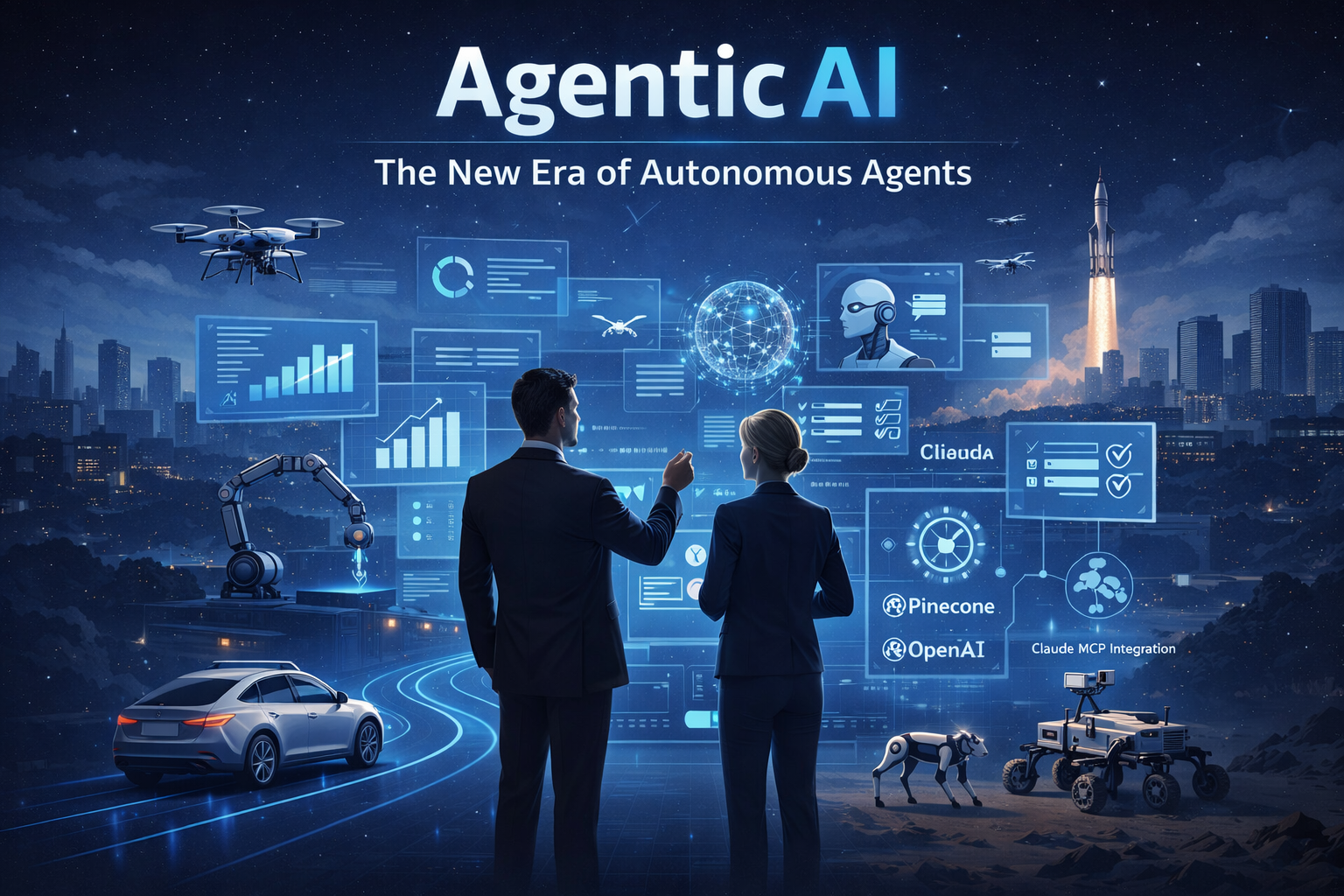
Agentic AI represents a shift from single-response systems to goal-oriented, multi-step AI systems capable of planning, acting, using tools, evaluating outcomes, and iterating over time — clearly distinct from chatbots, generative AI, ML models, or workflow tools like n8n.

Download as PDF

1 — Overview

Overview

What is Agentic AI?

Agentic AI refers to AI systems designed to pursue objectives across multiple steps by reasoning about actions, interacting with tools or external systems, maintaining state, and adapting behavior based on outcomes. They are not “one question, one answer”: they operate in workflows.

Key distinction
A traditional AI system answers questions.
An agentic AI system operates within workflows and uses tools to achieve goals.
CharacteristicAgentic AI
Goal-orientedYes — works toward a defined outcome
StatefulMaintains memory and context across steps
Tool usageNative — calls APIs, DBs, code, external services
IterationMulti-step reasoning, act–observe–evaluate loops
2 — What Are AI Agents?

What Are AI Agents?

What Are AI Agents?

An AI agent is an autonomous software entity that perceives its environment (e.g. user input, data, API responses), reasons about what to do next, and takes actions (calling tools, querying databases, running code) to achieve a goal. Unlike a single model call, an agent can loop: plan → act → observe → re-plan until the goal is met or a stop condition is reached.

  • Autonomy: Decides which actions to take, within guardrails.
  • Tool use: Integrates with external systems (APIs, files, databases, apps).
  • State: Keeps context and history across the conversation or session.
  • Goal-directed: Success is measured by outcome, not by a single “good” reply.
In short: AI agents = reasoning + tools + state + goals. They are the building blocks of agentic AI systems.
3 — How They Differ

How They Differ

How AI Agents Differ: Chatbots, Generative AI, Machine Learning & n8n

Confusion is common. Below we clarify what each term means and how AI agents differ from chatbots, generative AI, classical machine learning, and workflow automation tools like n8n.

Chatbots

What they are: Conversational interfaces that typically send each user message to a model and return one (or a few) responses. Turn-by-turn Q&A; little or no persistent goal, tool use, or multi-step planning.

Agents vs chatbots: Agents are goal-oriented and use tools. They can run many steps (search, code, DB, API) and maintain state. A chatbot usually answers the current message; an agent works toward an outcome (e.g. “book this trip”, “reconcile this report”).

Generative AI (GenAI)

What it is: A class of models that generate content (text, images, code, etc.) from prompts. The capability is “generate something,” not “achieve a goal by acting in the world.”

Agents vs GenAI: GenAI is a capability (generation). Agents use GenAI (e.g. an LLM) as the reasoning engine and add goals, tools, state, and control logic. So: GenAI = engine; agent = system that uses that engine to act and iterate.

Machine Learning (ML)

What it is: Algorithms that learn patterns from data (classification, regression, prediction). Usually one input → one output; no built-in notion of “tools” or multi-step goals. Often batch or real-time inference, not interactive loops.

Agents vs ML: ML models are typically stateless predictors. Agents are stateful, interactive, tool-using systems. An agent may use ML/LLM inside its reasoning loop, but the agent is the orchestrator with goals and actions.

n8n (and similar workflow tools)

What it is: n8n is a workflow automation platform: you define nodes (triggers, actions, conditions) and edges in a graph. Execution is deterministic — the path is defined by the graph and data, not by an AI “deciding” what to do next.

Agents vs n8n: n8n is rule- and graph-driven; the flow is designed by humans. Agents are goal-driven and adaptive: the AI chooses which tools to call and in what order. You can combine both: e.g. an agent that triggers or is triggered by n8n workflows, or an agent that calls n8n as one of its tools.

ConceptMain traitAgentic AI difference
ChatbotTurn-by-turn conversation, single responseAgents: goals, tools, multi-step, state
Generative AIGenerate content (text, image, code)Agents use GenAI as engine + add tools & goals
Machine LearningLearn from data, predict/classifyAgents: stateful, interactive, tool use, orchestration
n8n / workflow automationDeterministic graph of stepsAgents: AI-driven choice of actions; can use n8n as a tool
4 — Core Concepts

Core Concepts

Core Concepts

  • Goal definition: Clear objective beyond a single response
  • Reasoning: Deciding what to do next (often via an LLM)
  • Action: Interacting with tools or systems (APIs, DB, code)
  • State: Storing intermediate decisions and results
  • Evaluation: Checking correctness and constraints
Goal → Reason → Act → Observe → Evaluate → Continue or Stop
5 — Architecture

Architecture

Basic Agentic Architecture

LayerResponsibility
Reasoning enginePlans and decisions (e.g. LLM)
Memory / StateContext and history
Tool interfaceAPIs, databases, services
Control logicStop, retry, escalation
EvaluationQuality and safety checks
Strong systems separate deterministic logic (calculations, validation) from agentic reasoning (interpretation and decision-making).
6 — Key Elements

Key Elements

Key Agent Elements — An Integrated View

An AI agent is an integrated solution that performs several steps with reasoning based on deterministic (rules, validation, calculations), probabilistic (LLM generation, ranking), and agentic (goal-driven, tool-using, iterative) logic. The key elements work together like a system:

ElementRoleAnalogy
PromptUser input, instructions, contextTalking — what we say to the system
LLMReasoning, planning, generationBrain — interprets and decides
RAGRetrieval-augmented knowledge from documentsKnowledge — grounds answers in facts
MCPModel Context Protocol — tools, APIs, external systemsNervous system — connects to the world
AI AgentOrchestrates all elements in multi-step workflowsIntegrated solution — deterministic + probabilistic + agentic
Integrated reasoning
The agent combines deterministic (fixed rules, validation), probabilistic (LLM outputs, confidence scores), and agentic (goal-driven loops, tool calls) reasoning. It is not “one mode” — it orchestrates all three across steps.

Integral Diagram — Key Agent Elements

The flow below shows how the elements connect: prompt (input) → LLM (reasoning) → RAG (knowledge) + MCP (tools) → agent (orchestration) → output.

Prompt
Talking
LLM
Brain
RAG
Knowledge
+ MCP
Nervous System
AI Agent
Integrated Solution
Deterministic · Probabilistic · Agentic reasoning
7 — Applications

Applications

Common Applications

  • Data and Excel reconciliation
  • Incident response workflows
  • Policy and compliance interpretation
  • Multi-system operational automation
  • Research and synthesis tasks
  • Orchestrating n8n or other workflows as one of many tools
8 — Quiz

Quiz

Interactive Quiz

Q1. What makes an AI system agentic?

Q2. What should remain deterministic?

Q3. How do agents differ from n8n-style workflows?

9 — FAQ

FAQ

Frequently Asked Questions

Is agentic AI just prompt engineering?
No. It requires architecture, control logic, UX, evaluation, and governance.

Do agentic systems replace software?
No. They orchestrate and augment existing systems (including tools like n8n).

Is full autonomy required?
Most enterprise systems operate in assisted or conditional autonomy.

Can I use n8n with agents?
Yes. n8n can be one of the tools an agent calls, or workflows can trigger/invoke agents.

10 — FAQ

FAQ

Frequently Asked Questions

Is agentic AI just prompt engineering?
No. It requires architecture, control logic, UX, evaluation, and governance.

Do agentic systems replace software?
No. They orchestrate and augment existing systems (including tools like n8n).

Is full autonomy required?
Most enterprise systems operate in assisted or conditional autonomy.

Can I use n8n with agents?
Yes. n8n can be one of the tools an agent calls, or workflows can trigger/invoke agents.

Rate this article

Share your feedback

Optional: send a comment about this article.